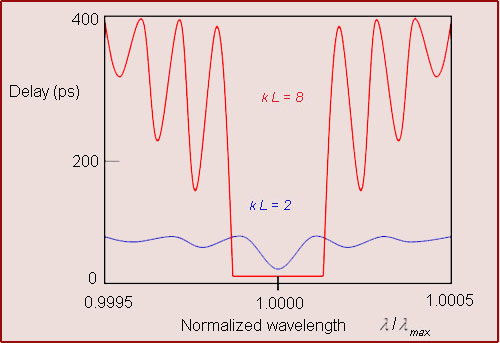
The plot of reflection coefficient and delay as a function of wavelength are shown in Figs.
Following things can be noted from the amplitude and delay plots.
(1)
The fractional bandwidth of the FBG is extremely narrow (of the order of 0.01%). That means the FBG is an extremely tuned wavelength filter. At 1550nm wavelength we can achieve a bandwidth as narrow as 0.2-0.3nm.
(2)
For low value of the reflectivity is less than 1 but as increases, the reflectivity saturates to 1, and the bandwidth of the FBG increases. So by using FBG of proper parameters a perfect reflection of the signal can be obtained from an FBG.
(3)
In the pass band the delay is small and constant. Whereas on the edge of the pass band the delay rapidly increases as a function of wavelength, making the FBG dispersive.
(4)
The frequency response has rather high side lobes.


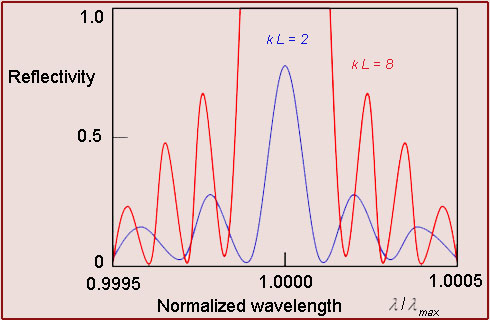
 the reflectivity is less than 1 but as
  increases, the reflectivity saturates to 1, and the bandwidth of the FBG increases. So by using FBG of proper parameters a perfect reflection of the signal can be obtained from an FBG.