In a WDM system different wavelengths attenuate by different amount. Also in devices like the EDFA, the gain is not uniform across the band. This causes different SNR and consequently different BER in different channels.
The gain of different channel has to be equalized for identical performance of all the channels.
By controlling the FBG parameters, the reflectivity of different wavelengths can be controlled. In this case the FBG is not used in saturation mode. The wavelengths which have higher gain can be reflected with low reflection coefficient.
By varying the visibility and the chirp of the grating complex reflection profiles can be realized for gain equalization.
Mode Converter
Normally the SM fiber carries mode. However for dispersion compensation using dispersion compensating fibers, the signal has to be converted from mode to mode and vice versa.
A tilted FBG as shown in Fig can be used for this purpose.
The grating is tilted by few degrees with respect to the axis of the fiber. This causes coupling between circularly symmetric and circularly anti-symmetric modes and power from is converted to mode and vice versa.
Sensor
Temperature Sensor
The FBG also has non-communication application. One of its important use is a s a pressure or temperature sensor.
Due to variation of temperature the fiber length changes and consequently the grating period changes. The Bragg wavelength then deviates from the original FBG wavelength.
By measuring the deviation of the wavelength of the reflected signal one can estimate the temperature.
Temperature to an accuracy of a fraction of a degree can be achieved using fiber sensors.
Pressure Sensor
In pressure sensor, a normal fiber is passed through corrugated plates. The plates introduce a mechanical periodicity and therefore the fiber acts like a grating. There is no permanent grating in this case.
Now as the pressure between the plates increases, the modulation of grating increases and the reflectivity increases.
With proper calibration, the pressure can be measured by measuring the strength of the reflected signal.


 mode. However for dispersion compensation using dispersion compensating fibers, the signal has to be converted from
  mode to
  mode and vice versa.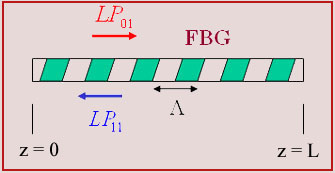
 is converted to
  mode and vice versa.
