If a hydrogen loaded fiber core is exposed to intense ultra violate beam, the refractive index of the fiber gets modified permanently.
Now, making two coherent ultra violate beams interfere on the core of the fiber, the fiber is exposed to periodic ultra violate intensity variation. This then causes a permanent periodic variation of the refractive index of the core.
The peak change in refractive index is of the order of
.
The mode coupling phenomenon is week and one need a substantial length of the FBG to achieve good reflection of the signal. The size of the FBG is typically few thousand wavelengths.
According to the mode coupling phenomenon the two modes show strong coupling if they satisfy the Bragg condition
Where, and are the phase constants of the two modes, is the period of the variation of the refractive index (it is assumed that the variation is sinusoidal), and is an integer which defines the order of diffraction. For first order, .
Now if we take two identical counter propagating modes,
And the Bragg diffraction condition becomes
Now if the effective modal index is , , where is the wavelength of the signal. The Bragg condition then gives the wavelength called the Bragg wavelength which is strongly reflected by the grating as
The important this to note here is that the period of the refractive index variation is of the order of the wavelength to be reflected. In optical communication since the wavelengths lie in the range of 1-2 m, the grating period has to be of the order of 2-4 m.
The fabrication of FBG therefore is little difficult, however once the grating is made, it offers very stable performance.


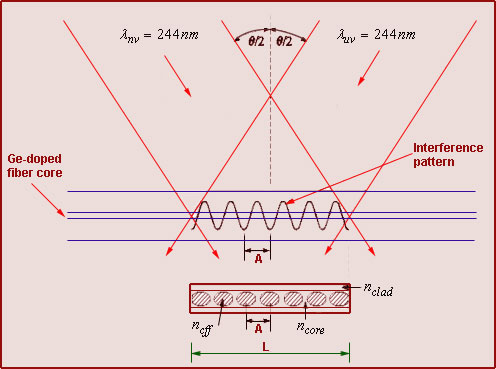
 .
. 
 and
and  are the phase constants of the two modes,
  is the period of the variation of the refractive index (it is assumed that the variation is sinusoidal), and
  is an integer which defines the order of diffraction. For first order,
  .
.

 ,
,  , where
  is the wavelength of the signal. The Bragg condition then gives the wavelength called the Bragg wavelength
  which is strongly reflected by the grating as
 m, the grating period has to be of the order of 2-4
  m.
m. 
