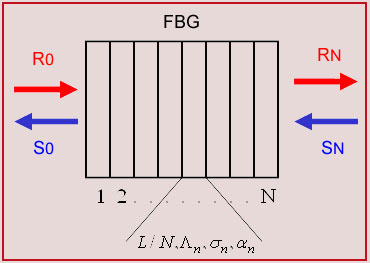
A non-uniform FBG is analyzed by dividing the FBG into small sections. It is then assumed that over the small section the FBG parameters are constant. That is the a non-uniform grating is approximated by a piece-wise uniform grating.
Let the FBG be divided in N-sections as shown in Fig.
The forward and backward signals at the Nth section are written as
And for nth section we have
For a good convergence the FBG has to be divided into few hundred sections.
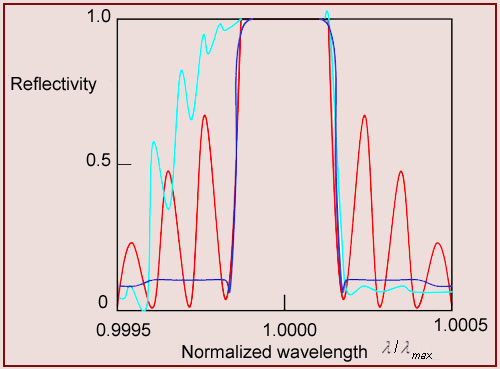
Figure shows the frequency response of three FBGs, namely Uniform, Gaussian Apodized, and Zero-Mean Gaussian.
As can be seen the zero-mean Gaussian FBG has good roll-off and very low side lobes. In practice therefore the apodized FBGs are more useful.
The Gaussian apodized gratings show mush higher delay compared to the uniform grating.
The chirped gratings have very large dispersion.
With today's technology gratings can be fabricated with a very high precision and their characteristics can be reproduced to a high accuracy.
The FBG based devices have gain popularity in modern optical communication systems, especially the DWDM systems. Some of the applications are explained in the following.