The Fiber Bragg gratings are analyzed using coupled mode theory. The formulation is very similar to that of a directional coupler discussed in the integrated optics section.
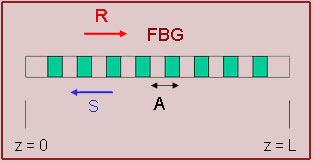
A schematic of a uniform FBG is shown in Fig. Here uniform FBG means, it has constant period and constant peak amplitude of the refractive index variation through out the length of the FBG.
Let the FBG has a spatial period and length . Let there be two identical modes propagating in opposite directions. Let R denote the amplitude of the forward mode and S denote the amplitude of the backward mode.
As given above, a wavelength is strongly reflected if it satisfies the Bragg condition. However, here we would like to see what is the frequency response of the FBG, that is how the reflectivity changes as a function of the wavelength around the Bragg wavelength.
Let the refractive index of the FBG be given as
Where is the peak change in refractive index.
The amplitudes of the forward and backward waves are governed by the following coupled differential equations.
Where we have defined
DC coupling coefficient :
AC coupling coefficient :
Tuning parameter :
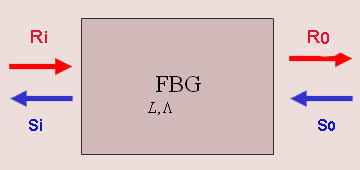
Let us now consider the FBG as a 4-port device as shown in Fig.
The solution of the coupled equation can be written as
Where
The matrix representation would come handy when we investigate the non-uniform FBGs.
The Amplitude reflection coefficient of the FBG then can be obtained by making as


 and length
  . Let there be two identical modes propagating in opposite directions. Let R denote the amplitude of the forward mode and S denote the amplitude of the backward mode.
 is the peak change in refractive index.





 as
as 

