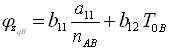
Equation (6.88) can be expanded as
 |
(6.89) |
and
 |
(6.90) |
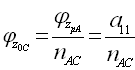
Branch C and junction point: At branch point, between shafts A and C, we have the following condition (noting equation(6.86) )
 |
(6.91) |
where nACis the gear ratio between shafts A and C. Another condition at the branch (among shafts A, B and C) to be satisfied regarding work done by the torque transmitted at various branches (assuming negligible friction during transmissions), i.e.
 |
| (6.92) |
On substituting equation (6.90) into equation (6.92), it can be written as
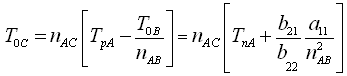
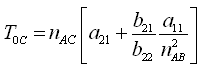
On substituting equation (6.86), we get
 |
(6.93) |
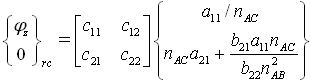
Substituting equations (6.91) and(6.93) into equation(6.84) for branch C, we get
 |
(6.94) |
where Trc = 0 is the boundary condition describing the free right hand end of branch C.
The frequency equation: From equation (6.94), the second equation will give the frequency equation as
 |
(6.95) |
where a’s, b’s and c’s are function of the natural frequency, ωnf. The roots of the above equation are system natural frequencies. We expect (p + q + r + 1) number of roots.