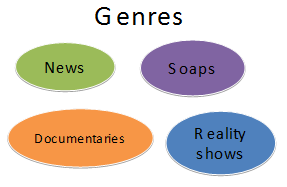
Let us now consider the genres or types of programmes that are in television as a media / cultural form. Broadly speaking, we may say that the chief genres are the following:
Simon During refers to the initial lack of semiotic or close-reading methods in the study of television programs:
“Traditionally at least, most cultural studies work on television has concentrated on audience reception which is a sign of the medium's lack of cultural value . It is as if the programmes themselves are not worth taking as seriously as their impact on viewers. So it has been impossible to concentrate on close readings of TV texts or to construct a TV canon.”
The content of television was seen traditionally at least as not being amenable to much serious analysis though these texts are potentially very rich in their semiotic content. Without text based or semiotic criticism these texts will not be seen by scholars as having enough research potential as far as their content was concerned .
In The Sage Dictionary of Cultural Studies Chris Barker remarks:
“Cultural studies writers have sought to study television as a socially and culturally informed activity that is centrally concerned with meaning so that the main focus of interest has been on the interplay between texts and audiences. Here texts are understood to be polysemic , that is, they are carriers of multiple meanings only some of which are taken up by audiences… Consequently, differently constituted audiences will work with different textual meanings .”