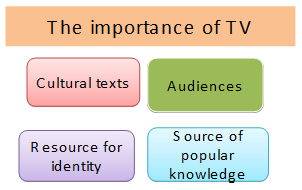
Certain characteristics of television were ‘in sync' with the orientation of Cultural Studies, especially, as During notes above, its breaking down of the barriers between ‘low' and ‘high culture' and its populist nature. The fact that television was immensely popular and that audiences from various segments of society could peruse its products whereas high culture products were not available to all segments of the population, was an important cultural phenomenon. Its emphasis on cultural reception as a “life practice rather than on interpretation or production” (During) is another important pattern which will be unpacked a little later when we refer to television audiences.
It is not that Cultural Studies found only the interpellative aspects of television to be amenable to cultural analyses, but also that reception of television programmes as cultural forms was much more rich and not simply a one-sided traffic between the media and the audience. This was also found to be an area of study that had immense potential for research.
Television is a centre of attention in the interface between Cultural Studies and media studies both as a discourse and as a product. However, as During remarks:
“Of course, in being shaped by TV, cultural studies is by no means unique: it is just about impossible to imagine contemporary party politics, sport, music, film, and indeed consumer culture generally outside of their complex interactions with the box.”
Such is the importance of television as a major source of knowledge, pleasure and entertainment. Television is a crucial resource of identity; indeed it is a powerful tool of identity negotiation. It is definitely a growing alternative source of knowledge production, distribution and consumption, especially of popular knowledge.