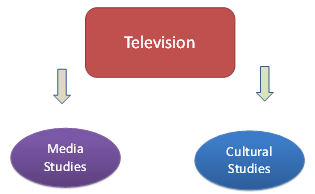
Let us begin with a quotation from Simon During on his essay on television:
“ Television, as the dominant medium of the period, has a unique relation to cultural studies which, it's clear, has been formed around its encounter with TV . The discipline's turn to populism and devaluation of high culture; its emphasis on cultural reception as a life practice rather than on interpretation or production; its sense of cultural consumers as segmented, all owe much to its contiguity to television and to a TV-centred understanding of the media.”
Indeed, t he interface of media studies with Cultural Studies was first perhaps inspired or motivated by television as a media and cultural form. Cultural Studies found television as a part of mass culture a fertile area that had tremendous scope because it reached large audiences and the representations made were fruitfully open both to semiological analyses as well as analyses from the point of view of political economy.