Cultural Studies finds television a fertile domain of study since it can be explored from many perspectives. Most of these may be clubbed under one of the following areas of study:
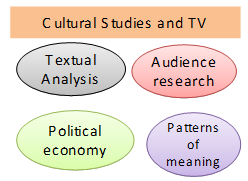
We know that Cultural Studies has a strong textual approach, investigating the way signs are encoded and decoded. Any television programme, be it a soap opera or a news bulletin, is highly amenable to semiological analyses: how does the programme represent an event / person / community? What images, symbols and discourses are used in the creation of meaning and signification? What ideology is being foregrounded through the representations and symbols? Several such questions are asked in cultural analyses of television.
Second, a growing area or perspective is the study of audiences, of their reception and resistance of programmes, their recreation and reinscription of meaning. Third, the nature of the medium is such that certain patterns of meanings and values emanate and once we get into the patterns of meaning, these then can powerfully shape our perception of society, knowledge, communities, ethnic groups, nations etc. Fourth, if we do not look at the relations of production in the television industry or if we do not consider what goes into production, distribution and consumption processes then it remains only a surface level investigation of television. A political economy analysis is something that we can never do without even if we make a textual analysis.
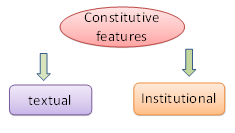
Therefore, we may summarize this in another way by saying that the constitutive features of television as a domain of enquiry in Cultural Studies could be said to be twofold: