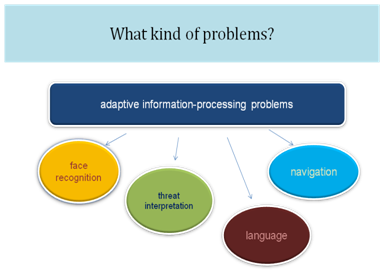
Now the question arises, what kinds of problems were being faced? For instance, these are adaptive, information-processing problems.
1) Face recognition , whether it recognizes the face of your mother, your enemy or your child
2) Threat interpretation , the ability to interpret threats, gauging an action or a gesture in terms of whether it is a threat or not
3) Language is an adaptive problem in response to the need that has to be developed for a group co-operation, in naming things, in transmitting information, however elementary it seems to us
4) Navigation in an environment so that we are able to survive and not perish.
According to evolutionary psychology the adaptive problems like threat interpretation, language and navigation are core to us and they have given rise to a certain kind of brain circuitry.
Let us read from Tooby and Cosmides:
“In other words, the reason we have one set of circuits rather than another is that the circuits that we have were better at solving problems that our ancestors faced during our species' evolutionary history than alternative circuits were. The brain is a naturally constructed computational system whose function is to solve adaptive information-processing problems (such as face recognition, threat interpretation, language acquisition, or navigation).”
“Over evolutionary time, its circuits were cumulatively added because they “reasoned” or “processed information” in a way that enhanced the adaptive regulation of behavior and physiology.”
We may summarize this in the following way:
• Circuits are cumulative.
• They are there for adaptive regulation of behavior and physiology.