The theory of differential reproduction holds that those individuals who are best equipped to survive the longest will produce more offspring than individuals who have shorter life spans. Here we are not talking about survival per se or reproduction per se, but we are pointing to the differential . That is, the difference between those who have preserved the variations that are profitable to them and those who have not and those who have shorter life spans and hence are not able to pass on those traits to progeny.
An important point as stated by Tooby and Cosmides is that Natural Selection does not always work for the good of the species i.e., Natural Selection does not always work for the benefit of the species as we think. Hence the phrase “blind Natural Selection.”
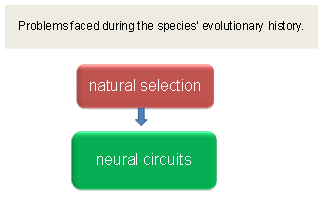
Now let us look at the other aspect of the principle, that the problems of the brain have developed to solve adaptive problems in relation to a changing environment, problems which were faced during our species' evolutionary history. Natural Selection gives rise to certain neural circuitry. These circuits have been designed by Natural Selection. These neural circuits have come to be what they are because they have been solving certain problems. These problems are not contemporary problems but have been there in our evolutionary past and have led to a certain kind of neural circuitry which is common to all of us as a species.