Let us move on to Principle 3 which looks at one of the fundamental problems of cognitive science, of philosophy and of literature, among other fields of study: “What is consciousness?”
Principle 3
“Consciousness is just the tip of the iceberg; most of what goes on in your mind is hidden from you. As a result, your conscious experience can mislead you into thinking that our circuitry is simpler that it really is. Most problems that you experience as easy to solve are very difficult to solve – they require very complicated neural circuitry.”
We may understand consciousness simply as awareness: we are aware about our surroundings, say, you are aware that you are reading this lecture. At a deeper level we can consider consciousness as a subjective experience: what we feel, understand, and experience as an individual in our world is termed consciousness. Another way of looking at consciousness is as the wakefulness of the mind.
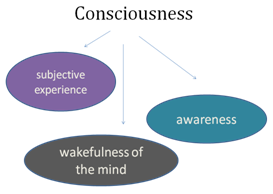
Consciousness involves a circuitry which is far complex than what we think it to be. Recognizing or looking at a person as one's mother involves many processing levels and areas and of the brain, of inputs from many diverse levels. So we should not think that consciousness is very easy to understand or that it can be understood in a very simplistic manner.
Thus this is what Tooby and Cosmides say:
“The only things you become aware of are a few high level conclusions passed on by thousands and thousands of specialized mechanisms: some that are gathering sensory information from the world, others that are analyzing and evaluating that information, checking for inconsistencies, filling in the blanks, figuring out what it all means.”
For a single act of perception there is the involvement of thousands and thousands of specialized mechanisms. We are hardly aware of them. The point here is that all these processes are not available to us or we do not realize that these processes are taking place. If we look at every human action, however trivial, effortless, natural and simple it may appear to us, it is actually a lot more complicated. A small action may appear to us as not at all complicated. Each task which appears deceptively simple to us has many sub functions, performed by thousands of specialized mechanisms and we only get to know the final result, which we call our conscious experience. In the sense that when we recognize our mother as our mother or our teacher as our teacher, this is the final result of our conscious experience. For this simple event, there are specialised mechanisms that are going on in our minds.
As the authors put it:
“To find someone beautiful, to fall in love, to feel jealous – all can seem as simple and automatic and effortless as opening your eyes and seeing. So simple that it seems like there is nothing much to explain. But these activities feel effortless only because there is a vast array of complex neural circuitry supporting and regulating them.”