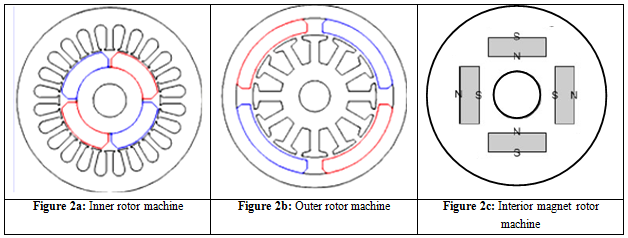
Based on the construction of the rotor, the PM machines can be broadly classified into three categories:
- Inner rotor machine (Figure 2a)
- Outer rotor machine (Figure 2b)
- Interior magnet rotor (Figure 2c)
Principle of Operation of PM Machine
To produce torque, in general, a rotor flux and a stator mmf has to be present that are stationary with respect to each other but having a nonzero phase shift between them. In PM machines, the necessary rotor flux is present due to rotor PMs. Currents in the stator windings generate the stator mmf. The zero relative speed between the stator mmf and the rotor flux is achieved if the stator mmf is revolving at the same speed as the rotor flux , that is, rotor speed and also in the same direction. The revolving stator mmf is the result of injecting a set of polyphase currents phase shifted from each other by the same amount of phase shift between the polyphase windings. For example, a three phase machine with three windings shifted in space by electrical 120° between them produces a rotating magnetic field constant in magnitude and travelling at an angular frequency of the currents (just as in case of Induction machines). The rotor has permanent magnets on it, hence the flux produced by the rotor magnets start to chase the stator mmf and as a result torque is produced. Since the relative speed between the stator mmf and rotor flux has to be zero, the rotor moves at the same speed as the speed of the stator mmf. Hence, the PM machines are inherently synchronous machines.
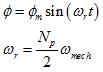
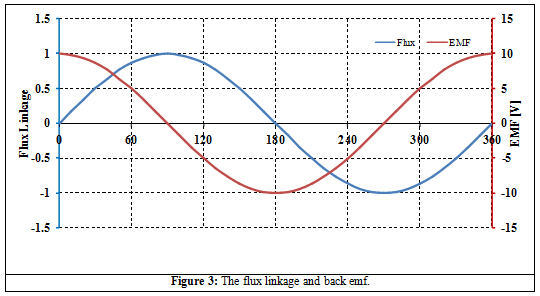
As the coils in the stator experience a change of flux linkages caused by the moving magnets, there is an induced emf in the windings. The shape of the induced emf is very dependent on the shape of the flux linkage. If the rotational electrical speed of the machine ωr and the air gap flux is sinusoidal then it can be expressed as (Figure 3)
where Φm is the peak flux produced |
(1) |