Introduction
The topics covered in this chapter are as follows:
- Permanent Magnet (PM) Machines
- Principle of Operation of PM Machine
- Operation of PM Machine Supplied by DC-AC Converter with 120° Mode of Operation
- Operation of PM Machine Supplied by DC-AC Converter with 180° Mode of Operation
Permanent Magnet (PM) Machines
By using high energy magnets such as rare earth based magnets, a PM machine drive can be designed with high power density, high speed and high operation efficiency. These advantages are attractive for their application in EVs and HEVs. The major advantages of PM machines are:
- High efficiency : The PM machines have a very high efficiency due to the use of PMs for excitation which consume no power. Moreover, the absence of mechanical commutators and brushes results in low mechanical friction losses.
- High Power density : The use of high energy density magnets has allowed achieving very high flux densities in the PM machines. As a result of high flux densities, high torque can be produced from a given volume of motor compared to other motors of same volume.
- Ease of Control : THE PM motors can be controlled as easily as DC motors because the control variables are easily accessible and constant throughout the operation of the motor.
However, the PM machines also suffer from some disadvantages such as:
- Cost : Rare-earth magnets commonly used in PM machines are very expensive.
- Magnet Demagnetization : The magnets can be demagnetized by large opposing magnetomotive force and high temperatures.
- Inverter Failure : Due to magnets on the rotor, PM motors present major risks in the case of short circuit failures of the inverters. The rotor is always energized and constantly induces EMF in the short circuited windings. A very large current circulates in those windings and an accordingly large torque tends to block the rotor. The dangers of blocking one or several wheels of a vehicle are non-negligible.
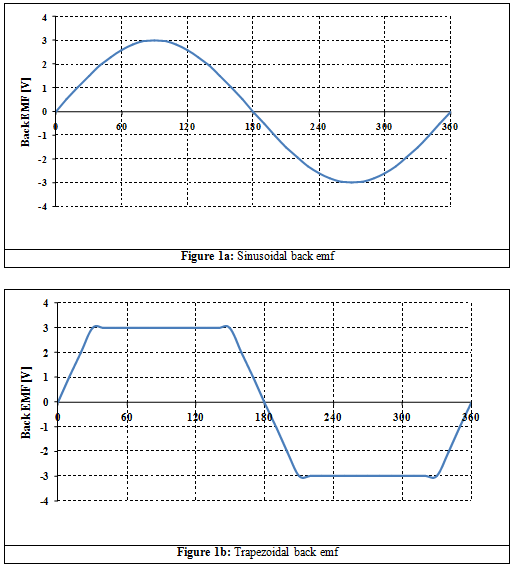
Based on the shape of the back e.m.f induced in the stator windings, the PM motors can be classified into two types:
- Permanent Magnet Synchronous Machine with sinusoidal back e.m.f ( Figure 1a )
- Brushless Permanent Magnet DC Machines (BLDC) with trapezoidal back e.m.f ( Figure 1b )