How to Create the Second Magnetic Field
From equation 1 it can be seen that to produce torque two magnetic fields are required. The rotating magnetic field created by the stator has been discussed in the previous section and this section deals with the generation of rotor magnetic field. There are multiple ways to produce the rotor magnetic field namely:
- Having windings on the rotor and exciting then with dc current to produce magnetic field (known as Synchronous Machines ).
- Having permanent magnets on the rotor to produce the rotor magnetic field (known as Permanent Magnet Synchronous Machines ).
- Utilize the Faradays law of induction to induce electromotive force (e.m.f) in the rotor coils. The induced e.m.f will result in flow of current through the rotor conductors and these currents will produce a magnetic field. These machines are known as Induction Machines or asynchronous machines .
Synchronous Machines
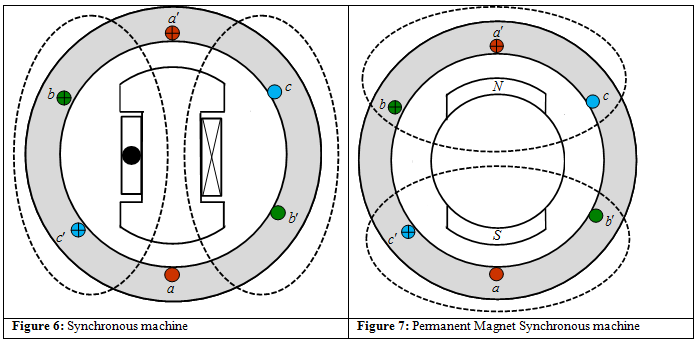
The general configuration of synchronous machine is shown in Figure 6 . It can be seen from Figure 6 that the rotor has a coil (denoted by a dot and a cross) and through this coil a dc current flows. Due to this dc current a pair of magnetic poles is created. The stator windings also create two magnetic fields that rotate with time and hence, the rotor's magnetic poles chase the stator's magnetic field and in the process electromagnetic torque is produced. The speed of rotation of rotor depends on the speed with which the stator's field rotates and hence, these machines are known as synchronous machine.
Permanent Magnet Synchronous Machines (PMSM)
In case of PMSM, the rotor field is created by permanent magnets rather than dc current passing through a coil (Figure 7). The principle of operation of PMSM is same as that of synchronous machine.