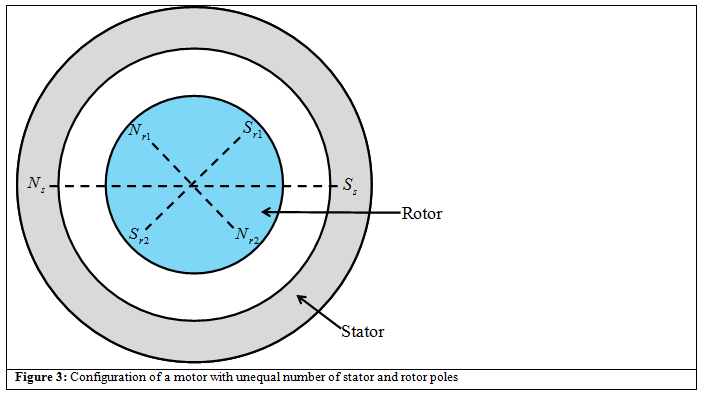
Now consider the pole pairs (Ns, Sr2) and ( Ss, Sr1), the angle between the pole pairs is same. Hence, the force of attraction between Ns and Sr2 is same as the force of repulsion between Ss and Sr1 and thus, the resultant force acting on the rotor is zero. Therefore, in this case no electromagnetic torque is developed.
From the above discussion it can be seen that the resultant electromagnetic torque developed due to two stator poles and 4 rotor poles is zero. This leads to the conclusion that in all rotating electric machines, the number of rotor poles should be equal to number of stator poles for electromagnetic torque to be produced .
How Continuous Torque is Produced by a Motor
In the previous section it has been seen that to produce electromagnetic torque, following two conditions have to be satisfied:
- Both stator and rotor must produce magnetic field
- The number of magnetic poles producing the stator magnetic field must be same as the number of magnetic poles producing the rotor magnetic field.