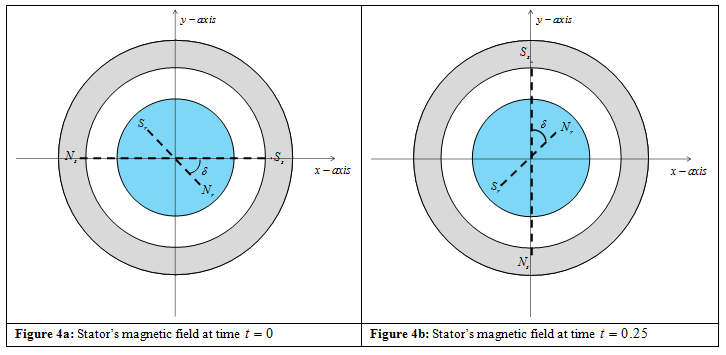
Now an important question that arises is how to create continuous magnetic torque ? To produce continuous torque the magnetic field of the stator should rotate continuously. As a result, the rotor's magnetic field will chase the stator's magnetic field and this result in production of continuous torque. This phenomenon is illustrated in Figures 4a - 4d. In Figure 4 a two pole machine is depicted and the rotors magnetic field is created by the permanent magnets. It is assumed that the stator's magnetic field rotates at a speed of 60 revolutions per minute (60 rpm) which is equivalent 1 revolution per second (1rps). To start the analysis it is assumed that at time t=0, the stator's magnetic field axis aligns itself with the x− axis and the rotor's magnetic field axis makes an angle δ with the stator's magnetic axis (Figure 4a). At time t=0.25s, the stator's magnetic field moves by 90° and the rotor's magnetic field chases the stator's field and aligns as shown in Figure 4b. Similarly the locations of the magnetic field axis at time t=0.5s and t=0.75s are shown in Figures 4c and Figure 4d .
From the above discussion and observing Figure 4 the following conclusions can be drawn:
- The rotor's magnetic field chases the stator's magnetic field.
- The angle (δ) between the stator's magnetic axis and the rotor's magnetic axis remains constant. Hence, the rotor's speed of rotation is same as that of the stator's magnetic field.
However, an important question that still remains unanswered is How to create a rotating magnetic field?