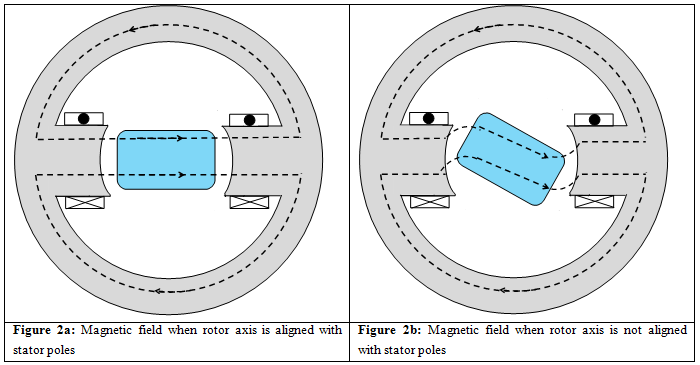
To realign the rotor from the position shown in Figure 2a to position shown in Figure 2b , a torque is exerted by the flux lines on the rotor. This torque is known as the reluctance or alignment torque .
Why Should the Number of Poles on Stator Equal to the Number of Poles on Rotor?
In the previous section it has been shown that to produce electromagnetic torque, the magnetic field produced by the stator has to interact with the magnetic field produced by the rotor. However, if the number of poles producing the stator magnetic field is not equal to the number of rotor poles producing the rotor magnetic field, then the net torque produced by the motor will be zero . This is illustrated by the motor configuration shown in Figure 3. In this motor the stator has two poles ( Ns, Ss) and the rotor has four poles (Nr1, Sr1, Nr2, Sr2,). The angle between the stator poles is 180o and the angle between the rotor poles is 90o. From the arrangement shown in Figure 3 it can be seen that the angle between Nr1 and Ns is equal to the angle between Nr2 and S. Hence, a repulsive force exists between Nr1 and Ns in clockwise direction and an attractive force exists between Nr2 and S in the anticlockwise direction. Both, the attractive and repulsive forces are of same magnitude and the resultant of these forces is zero.