Module 2 : Modeling Discrete Time Systems by Pulse Transfer Function

Lecture 5 : Sampled Signal Flow Graph

$ \dfrac {C^{*}(s)}{R^{*}(s)}$,     $ \dfrac {E^{*}(s)}{R^{*}(s)}$,      $ \dfrac{C(s)}{R^{*}(s)}$ can be computed from Mason's gain formula, as:

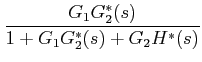
$\displaystyle \frac {C^{*}(s)}{R^{*}(s)}$
  $\displaystyle =$ $\displaystyle \frac {G_{1}G_{2}^{*}(s)}{1+G_{1}G_{2}^{*}(s)+G_{2}H^{*}(s)}$  

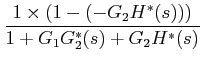
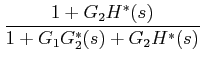
$\displaystyle \frac {E^{*}(s)}{R^{*}(s)}$
  $\displaystyle =$$\displaystyle \frac {1 \times (1-(-G_{2}H^{*}(s)))}{1+G_{1}G_{2}^{*}(s)+G_{2}H^{*}(s)}$  
       
    $\displaystyle =$$\displaystyle \frac {1+G_{2}H^{*}(s)}{1+G_{1}G_{2}^{*}(s)+G_{2}H^{*}(s)}$  

To derive $ \displaystyle \frac {C(s)}{R^{*}(s)}$: Number of forward paths = 2 and the corresponding gains are

  $\displaystyle \Rightarrow$ $\displaystyle 1\times 1\times G_{1}(s)\times G_{2}(s)= G_{1}(s)G_{2}(s)$  
  $\displaystyle \Rightarrow$ $\displaystyle 1\times G_{1}G_{2}^{*}(s)\times(-H(s))\times G_{2}(s)= -G_{2}(s)H(s)G_{1}G_{2}^{*}(s)$  

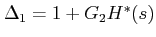
$ \Delta_{1}=1+G_{2}H^{*}(s)$ and $ \Delta_{2}=1$.

% latex2html id marker 642
$\displaystyle \therefore \frac {C(s)}{R^{*}(s)}=\fr...
..._{2}H^{*}(s)]-G_{2}(s)H(s)G_{1}G_{2}^{*}(s)}{1+G_{1}G_{2}^{*}(s)+G_{2}H^{*}(s)}$