Module 2 : Modeling Discrete Time Systems by Pulse Transfer Function

Lecture 5 : Sampled Signal Flow Graph

The input output relations:

$\displaystyle E(s)$
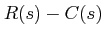
$\displaystyle =$ $\displaystyle R(s)-C(s)$ (3)
$\displaystyle C(s)$
$\displaystyle =$ $\displaystyle (G_{1}(s)E^{*}(s)-H(s)C^{*}(s))G_{2}(s)$ (4)
  $\displaystyle =$ $\displaystyle G_{1}(s)G_{2}(s)E^{*}(s)-G_{2}(s)H(s)C^{*}(s)$ (5)

The sampled SFG is shown in Figure 3(b).

To find out the composite SFG, we take pulse transform on equations (5) and (3):

$\displaystyle C^{*}(s)$
$\displaystyle =$ $\displaystyle G_{1}G_{2}^{*}E^{*}(s)-G_{2}H^*(s)C^{*}(s)$  
$\displaystyle E^{*}(s)$
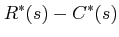
$\displaystyle =$ $\displaystyle R^{*}(s)-C^{*}(s)$  
  $\displaystyle =$ $\displaystyle R^{*}(s)-G_{1}G_{2}^{*}(s)E^{*}(s)+G_{2}H^{*}(s)C^{*}(s)$  

The composite SFG is shown in Figure 4.
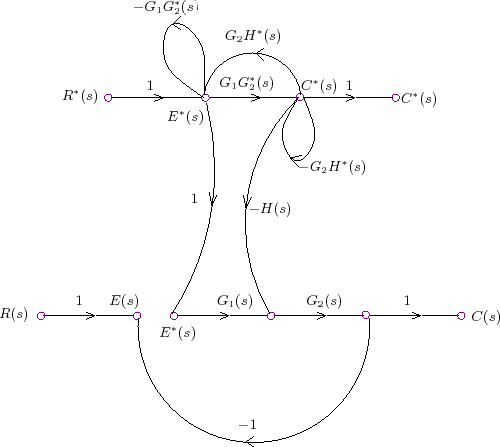
Figure 4: Composite signal flow graph for Example 2
\begin{figure}\centering\vspace{0.5cm}
\input{m2l5f4.pstex_t}\end{figure}