2.4 Bridging fault
A bridging fault is a short circuit between two or more cells. As in the case of coupling faults, to keep the number of faults within a practical number, it is assumed that only two cells can be involved in a bridging fault. There are two types of bridging faults
• AND bridging fault ANDibi,j (involving cells i and j) which results in values in cells i and j to be logic AND of the values in these cells under normal condition. AND bridging fault is represented by  where the first two places represent the values in cells i and j under normal condition and the two values following “|”represent the values in cells i and j under AND bridging fault.
  are the four types of AND bridging faults possible.
• OR bridging fault ORbfi,,j (involving cells i and j ) which results in values in cells i and j to be logic OR of the values in these cells under normal condition.  are the four types of OR bridging faults possible.
2.5 Neighborhood pattern sensitive coupling faults
One of the most important and different kind of fault in memory compared logic gate circuits is neighborhood pattern sensitive faults (NPSFs). As memory cells are very close to each other, the cells behave normally except for certain patterns in the neighborhood cells. For example, if a cell i has 0 and all the neighboring cells have 1, then the value of cell i may be pulled up to 1. It is obvious that given a cell there can be infinite number of neighborhood combinations. However for all practical cases there are two types of neighborhoods used in fault modeling for the cell under test.
• Type-1 neighborhood
Figure 8 shows a type-1 neighborhood. The black colored cell is the one under test and the four cells around it (filled by small check boxes) are called neighborhood cells. Patterns in the neighborhood cells cause faults in the cell under test. The numbering of cells in type-1 neighborhood is shown in Figure 9.
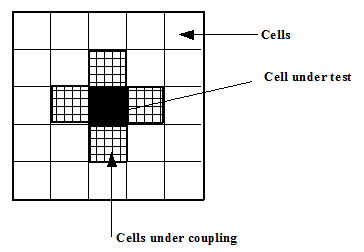
Figure 8. Type-1 neighborhood