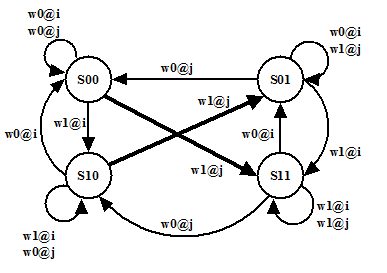
Figure 6. State diagram for memory cells (i,j) under ↑ inverse coupling fault cfinvij
2.3.2. Idempotent coupling faults
In a 2-indempotent coupling fault cfidij say, involving cells i and j , a transition (0 to1 or 1 to 0) in memory cell j sets the value in memory cell i to be 0 or 1. The four possible 2- idempotent coupling faults involving cells i ,j (denoted as cfidij ) are
• Rising-0:  (0 to1 change in cell j sets the content of cell i to be 0)
• Rising-1:  (0 to1 change in cell j sets the content of cell i to be 1)
• Falling-0:  (1 to 0 change in cell j sets the content of cell i to be 0)
• Falling-1:  (1 to 0 change in cell j sets the content of cell i to be 1)
Figure 7 shows the state machine for two cells i and j under rising-1 idempotent coupling fault cfidij. If we compare Figure 5 and Figure 7 we note that under normal condition if we write 1 to cell j (from state S00) we go to state S01, however, under rising-1 cfidijwe go to state S11. This situation is similar to ↑inverse coupling fault (Figure 6). However, unlike ↑ inverse coupling fault (Figure 6), in rising-1 idempotent coupling fault we do not have a faulty transition from S10 to S01.
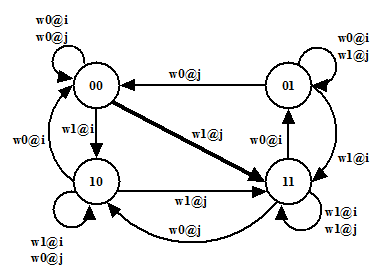
Figure 7. State diagram for memory cells ( i,j ) under Rising-1 idempotent coupling fault