2.3 Coupling Faults:
Coupling fault, as the name suggests, implies deviation from normal behavior of a cell because of coupling with others. As there can be exponential number of combinations of coupling of a cell with others cells, we assume that in coupling faults a faulty cell can get coupled with another faulty cell. In other words, in the widely used coupling fault model it is assumed that any “two” cells can couple and normal behavior changes in these two cells; it is called 2-coupling fault model. So if there are n cells in a memory then there can be nC2 number of 2-coupling faults. To reduce the number of 2-coupling faults further from nC2 we assume that only neighboring cells (decided on threshold distance) can be involved in the fault. We consider two types of coupling faults namely, (i) inversion coupling faults and (ii) idempotent coupling faults. Now we elaborate them as follows.
2.3.1 Inversion coupling faults.
In a 2-inversion coupling fault cƒinvi,j say, involving cells i and j, a transition (0 to1 or 1 to 0) in memory cell j causes an unwanted change in memory cell i. Memory cell i is the coupled cell (where fault occurs) and memory cell j is the coupling cell. The two possible 2-inversion coupling faults involving cells i,j (denoted as cƒinvi,j ) are
- Rising:
 (implying 0 to1 change in cell j complements the
content of cell i ) - Falling:
 (implying 1 to 0 change in cell j complements the
content of cell i )
Figure 5 illustrates the state diagram for two cells i and j under normal condition. State S00 implies that both the cells have 0 values; state S01 implies that cell i contains 0 and cell j contains 1. Similarly all the four states can be explained. The self loop at state S00 , marked w0@i implies that if 0 is written to cell i then the same state is retained; another transition w0@j is associated with the same self loop which implies that if 0 is written to cell j then S00 retained. However, if we write 1 to cell j (from state S00 ) i.e., w1@j , we go to state S01; this is indicated by the transition from S00 to S01 marked w1@j . Similarly the whole state machine can be explained.
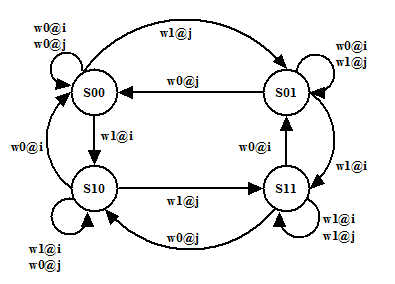
Figure 5. State diagram for two memory cells (i and j) under normal condition
Figure 6 shows the state machine for two cells i and j under rising inversion coupling fault cfinvij . If we compare Figure 5 and Figure 6 we note that under normal condition if we write 1 to cell j (from state S00 ) we go to state S01 , however, under rising cfinvij we go to state S11. This is explained as follows. When we write 1 to cell j in S00 it makes a 0 to 1 (rising) transition. As j is the coupling cell it complements the value of the coupled cell i (from 0 to 1). In Figure 6 the faulty transitions are indicated by thick arrows; S00 to S11 and S10 to S01 are two such transitions.