Module 2 : Global Positioning System
  Lecture 11 : Satellite geometry and Accuracy measures
Measures for 3-D
For 3-D positioning different error or accuracy measures are listed below:
Error Type Formula Associated Probability
Mean Radial Spherical Error (MRSE) 61%
Spherical Error Probability (SEP) 50%
It can be shown that                                 
It must be noted that the numbers indicating accuracies are meaningful only if corresponding accuracy measure is listed. For example, the achievable accuracies with SPS are can be given as (Seeber, 2003)

 
Horizontal 2D Standard Deviation Quality Measures
  • Often, horizontal (2D) position, can be expressed as sigma ( σ, standard error ) values which can be calculated for a normal distribution of one variable (univariate). For example, σN std. deviation of all Latitude (or Delta North) values with respect to the average Latitude (or North value). For various magnitudes (1σN, 2σN, etc.) the following interpretation follows from standard statistics:

N   68.3% of measured positions within 1σNvalue of average position
N   95.4% of measured positions within 2σNvalue of average position
N   99.7% of measured positions within 3σNvalue of average position.
N   Almost 100% of measured positions within 4σNvalue of average position.

Sigma 2D and Sigma 3D values

These are defined for 2-D and 3-D positions respectively. Standard deviation of the 2-D/3-D distance values from the average position are given by the following relations

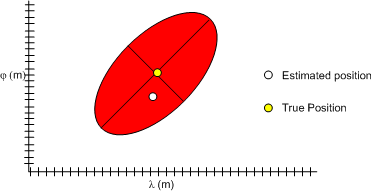
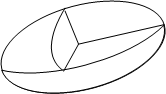
Horizontal confidence error ellipse (GPS Tutor, 1998):
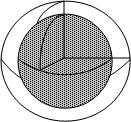
  • The probability of being within a certain region is described by confidence ellipse (2-D) or confidence ellipsoid (3-D) and represents an approximation of the true precision measures in all directions
  • Example : 95% horizontal error ellipse means that if the ellipse is centered on the true position, then there is a 95% chance of the estimated position lying within the boundary of the ellipse.
  • The size, shape and orientation of the a posteriori error ellipses depend on the particular satellite geometry and the prababilistic modeling strategy that has been adopted.
  • In practice, these will vary slowly with time (with satellite geometry) with step changes being seen mainly at times of satellites entering, or leaving, the configuration (i.e.; rising above, or dropping below the horizon or Elevation Mask settings- the angle of elevation below which all GPS satellites are discarded for position computation).


Figure 11.5 Confidence ellipse (GPS Tutor, 1998)

Table 11.1 summarizes various commonly used accuracy/error measures used in GPS surveying.

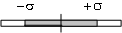
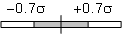
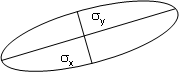
Table 11.1 Commonly used accuracy/error measures in GPS surveying

(1)
(2)
(3)
(4) Prob.
(5) Approximation
(6) Sketch
(7) Related Expressions
1D
rms
root mean square
68.3%*
σ 
MSE - mean square error (the square of the rms)
PE
probable error
50%*
0.674σ **
 
2D
error ellipse
39.4%*
defined by σxy
& correlation
 
CEP
circular error probable
50%*
radius:
0.589( σxy )+
CEP - also called CEP (circular probable error)
2drms
twice distance root mean square

varies
95.4 -9 8.2%+

radius:2σ +

2nd less common definition:
2 dimensional rms
(circle's radius 1σ)
3D
error ellipsoid
19.9%*
defined by σxy, σz 
& correlations
 
SEP
spherical error probable
50%*
radius:
0.513(σxy+ σz)*
SEP - also called SPE (spherical probable error)