| In
literature, different types of DOP designations are is
use. For example, GDOP, PDOP, etc. These are give below:
GDOP : Geometrical Dilution
of Precision, (measure of accuracy in 3-D position and time)
PDOP : Position Dilution of
Precision (measure of accuracy in 3-D position), also called
spherical DOP
HDOP : Horizontal Dilution
of Precision (measure of accuracy in 2-D position, for example
Latitude and Longitude)
VDOP : Vertical Dilution of
Precision (measure of accuracy in 1-D position, Height)
TDOP : Time Dilution
of Precision (measure of accuracy in Time)
PDOP is also interpreted as inversely proportional to
the volume, V,
of a tetrahedron that is formed from the satellite and user
positions ( PDOP α 1/V).
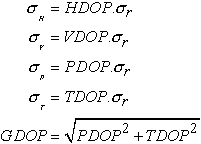
These DOP
values are related to positioning errors and UERE by the
following expressions where σr is UERE, σH, σV, σP
and σT are standard deviations in horizontal,
vertical, position (both horizontal and vertical), and time
respectively. |