Lecture 11 :
Satellite geometry and Accuracy measures
Mathematical interpretation
of DOP
Let:
t j satellite clock time at signal emission for satellite j ti receiver clock time at signal reception at receiver i
δj satellite clock delay
with respect to GPS time (the correct reference time) for satellite j
δi receiver clock delay with respect to GPS time for receiver i
However, t j and and ti are offset from actual GPS time. Hence,
Thus code pseudorange between receiver i and satellite j can be written as
Thus code pseudorange between receiver i and satellite j at an epoch t can be modeled as
True range between receiver at position i and satellite j , & given as
With approximate coordinates of the receiver, X i0, Y i0, Z i0
Expanding using Taylor series with
Hence, the pseudorange equation becomes
In short hand notation
The linearized least squares positioning equation for four satellites is given by L
= AX, where matrix A is given as
If angles of elevation from
the user to four satellites are Ei( i varies
from 1 to 4) and angles of azimuth of satellites from user
with respect to north are Azi( i varies
from 1 to 4), then various element of A matrix are
Using the Least Squares
Adjustment (Hofmann-Wellenhoff et al., 2004) it can be shown
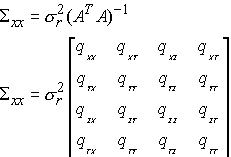
that the navigational covariance matrix for GPS positioning
is given by
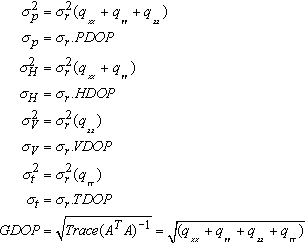
From covariance matrix, the variance of different position determination are given as
Each of these GDOP terms can
be individually computed but they are not independent of each
other.
The following points can be noted in this regard:
GDOP is a scalar quantity and a measure of the strength of the geometry of satellite configuration at an instant of time and not for the whole survey session of time.
Satellites spread around horizon provide the best horizontal
accuracy but weak vertical position. Conversely, if satellites
are at high altitudes, then precision in horizontal position
drops but in vertical position it improves.
Lower the GDOP/PDOP value, better the instantaneous point position solution.
PDOP values 4-5 are very good
PDOP values more than 10 are very poor
VDOP is typically around 4-5
Generally, GDOP and PDOP should be ≤ 5 and HDOP
should be between 2-3
In static surveys (explained later), it is desirable
to obtain observations during a time of rapidly changing
GDOP and/or PDOP
DOP values can be used to select appropriate combination
of satellites to provide best solution. PDOP values can be
computed from satellite ephemerides prior to conducting surveys.




 True range between receiver at position i and satellite j , & given as