| Accuracy measures
|
- Many different measures are used for describing the
accuracies obtainable from GPS in one-, two-, or three-dimension.
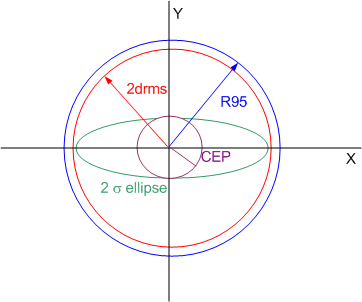
The most common two terms are 2DRMS and Circular error
probability (CEP). Figure 11.4 shows representation for
different types of accuracy measures (GPS Tutor, 1998).
- Other methods include simple statistical measures (normal distribution of one dimension) as in Sigma values .
|
2DRMS
|
- 2-dimensional position is given as Distance Root Mean Square (DRMS). It expresses the probability of being within a circle with radius DRMS varies between 63.2% and 68.3%.
|
|
- Alternative names for DRMS are Circular Radial Error or Mean Squared Position Error (MSPE)
- More commonly used term refers to twice of the DRMS ( 2DRMS) (not two-dimensional RMS or 2D-RMS, which is identical with DRMS). The probability is between 95.4% to 98.2%.

|
- Method to compute DRMS
Compute the rms of the radial errors, i.e. the linear distances between the measure and known (or mean) positions. It can be predicted by using covariance analysis by multiplying the HDOP, a measure of the satellite geometry, by the standard deviation of the observed pseudoranges. This predictability makes it a much more convenient measure in practice.
|
- Disadvantages
- It does not have a constant probability attached
to it.
- The associated probability is a function of the ellipticity of the relevant error ellipse resulting from a particular satellite geometry. On the assumption that the pseudorange errors are normally distributed, this probability lies in the range 95.4% to 98.2%.
|
| Circular Error Probable CEP
|
| Refers to the radius of a
circle in which 50% of the values occur. It defines the radius
of a circle, centered at the true position, containing 50%
of the estimated positions. For example, CEP of 50 meters
means that 50% of absolute horizontal point positions should
be within 50 meters of the true position.
|
|
Fgure11.
4 Different types of accuracy measures (GPS Tutor, 1998)
|
- It can be shown that

|
- Similarly other measures, for 95% and 99% probability may be

|
- To get the value, plot the results from a large number
of GPS fixes and draw a circle, centered on the mean (or
known position) that contained 95% (or 99% or 50%) of the
results. The radius of the circle would be the CEP95 (or
CEP50 or CEP99 ) value.
|
- Disadvantage: CEP, CEP95 or
CEP99 says nothing about the remaining 50% (or
5% or 1%) of the data (unless the probability density function
of the errors is known or assumed) and may hence hide the
possibility of there sometimes being some very large errors..
|