| |
| | |
|
Traffic islands to reduce the length of the crossing should be considered for
the safety of all road users.
It is used to permit safe crossing when insufficient gap in two directions
traffic & helps elderly, children and disabled.
- It works best when refuse area median is greater than cross walk
width or 3.6 m, have a surface area of at least 4.6 sq.m, are free of
obstructions, have adequate drainage, and provide a flat, street level surface
to provide accessibility to people with disabilities.
- The Refuge area width should be at least 1.2 m wide and depend
upon traffic speed.
It should be 1.5m wide on streets with speeds between 40-48 kmph, 1.8 m
wide(48-56 kmph), and 2.4 m (56-72 kmph).
Pedestrian facilities at-grade and as directly as possible are always preferred.
However, where grade separation is indicated, paths that are attractive,
convenient and direct can become well-used and highly valued parts of a city's
pedestrian infrastructure.
- These are expensive method but eliminate all or most conflicts.
These may be warranted for critical locations such as schools factory gates,
sports arenas, and major
downtown intersections (specially in conjunction with transit stations).
- Overpasses are less expensive than underpass.
However , vertical rise and fall to be negotiated by pedestrians is usually
greater for an overpass, and it may be aesthetically inferior.
- Minimum width is required 1.22 m, although 1.83 is preferred.
- Ramps slopes not greater than 1:12 (8.33%) are preferable to
flights of stairs to accommodate wheelchair, strollers, and bicycles and to
comply with ADA.
Available Time-Space: The total time-space available for circulation and queuing
in the intersection corner during an analysis period is the product of the net
corner area and the length of the analysis period.
For street corners, the analysis period is one signal cycle and therefore is
equal to the cycle length.
The following equation is used to compute time-space available at an
intersection corner.
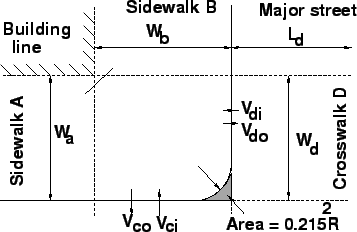
Intersection Corner Geometry is shown in Fig. 1.
 |
(1) |
where,
TS =available time-space ( -s), -s),
 = effective width of Sidewalk a (m), = effective width of Sidewalk a (m),
 = effective width of Sidewalk b (m),
R = radius of corner curb (m), and
C = cycle length (s). = effective width of Sidewalk b (m),
R = radius of corner curb (m), and
C = cycle length (s).
Figure 1:
Intersection Corner Geometry
 |
Pedestrian signals are designed basically considering minimum time gap required
for crossing the pedestrians.
This minimum time gap can be calculated by using following gap equation.
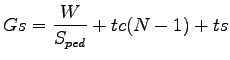 |
(2) |
where,
Gs=min time gap in sec,
W= width of crossing section,
ts= startup time,
tc=consecutive time between two pedestrian,
N=no of rows, and
 =pedestrian speed.
Calculate time gap for a platoon of 27 school children 5 in a row, consecutive
time 2 sec width of crossing section is 7.5 m and walking speed of children .9
m/s start up time 3 sec.
Solution
Given w=7.5m; tc= 3 sec = 0.9m/s
Find out N
N=27/5 i.e. 6 row (5 containing 5 & 6th containing 2)
Time gap =pedestrian speed.
Calculate time gap for a platoon of 27 school children 5 in a row, consecutive
time 2 sec width of crossing section is 7.5 m and walking speed of children .9
m/s start up time 3 sec.
Solution
Given w=7.5m; tc= 3 sec = 0.9m/s
Find out N
N=27/5 i.e. 6 row (5 containing 5 & 6th containing 2)
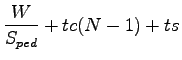
Time gap
|
|
| | |
|
|
|


![$\displaystyle [(7.5/0.9)+2(6-1)+3]$](img11.png)
