| |
| | |
|
The HCM uses pedestrian space as primary measure of effectiveness, with mean
speed and flow rate as secondary measures.
Provision of adequate space for both moving and queuing pedestrian flow is
necessary to ensure a good LOS.
Alternatively LOS considered as pedestrian comfort, convenience, perception of
safety and security.
Alternative LOS measurements consider specific constraints to pedestrian flow
such as stairway and wait time to cross roadways.
We are going to discuss LOS of walkways, LOS of queuing and LOS at signalized
intersection below.
Pedestrian Space   /p Flow Rate /p Flow Rate  p/min/m.
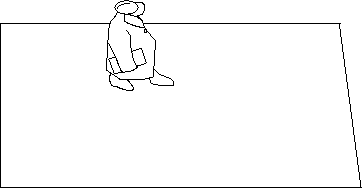
At a walkway LOS A, pedestrians move in desired paths without altering their
movements in response to other pedestrians.
Walking speeds are freely selected, and conflicts between pedestrians are
unlikely.
It is shown in Fig. 1. p/min/m.
At a walkway LOS A, pedestrians move in desired paths without altering their
movements in response to other pedestrians.
Walking speeds are freely selected, and conflicts between pedestrians are
unlikely.
It is shown in Fig. 1.
Figure 1:
LOS A
 |
Pedestrian Space  /p Flow Rate /p Flow Rate  p/min/m.
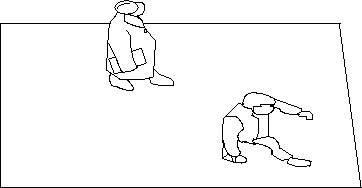
At LOS B, there is sufficient area for pedestrians to select walking speeds
freely, to bypass other pedestrians, and to avoid crossing conflicts.
At this level, pedestrians begin to be aware of other pedestrians, and to
respond to their presence when selecting a walking path.
It is shown in Fig. 2. p/min/m.
At LOS B, there is sufficient area for pedestrians to select walking speeds
freely, to bypass other pedestrians, and to avoid crossing conflicts.
At this level, pedestrians begin to be aware of other pedestrians, and to
respond to their presence when selecting a walking path.
It is shown in Fig. 2.
Figure 2:
LOS B
 |
Pedestrian Space  /p Flow Rate /p Flow Rate  p/min/m.
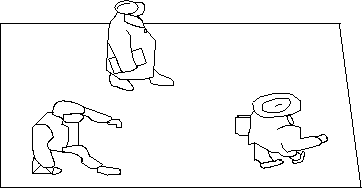
At LOS C, space is sufficient for normal walking speeds, and for bypassing other
pedestrians in primarily unidirectional streams.
Reverse-direction or crossing movements can cause minor conflicts, and speeds
and flow rate are somewhat lower.
It is shown in Fig. 3. p/min/m.
At LOS C, space is sufficient for normal walking speeds, and for bypassing other
pedestrians in primarily unidirectional streams.
Reverse-direction or crossing movements can cause minor conflicts, and speeds
and flow rate are somewhat lower.
It is shown in Fig. 3.
Figure 3:
LOS C
 |
Pedestrian Space  /p Flow Rate /p Flow Rate  p/min/m.
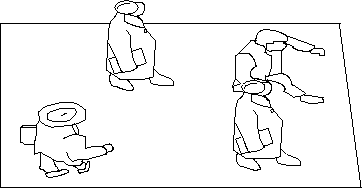
At LOS D, freedom to select individual walking speed and to bypass other
pedestrians is restricted.
Crossing or reverse flow movements face a high probability of conflict,
requiring frequent changes in speed and position.
The LOS provides reasonably fluid flow, but friction and interaction between
pedestrians is likely.
It is shown in Fig. 4. p/min/m.
At LOS D, freedom to select individual walking speed and to bypass other
pedestrians is restricted.
Crossing or reverse flow movements face a high probability of conflict,
requiring frequent changes in speed and position.
The LOS provides reasonably fluid flow, but friction and interaction between
pedestrians is likely.
It is shown in Fig. 4.
Figure 4:
LOS D
 |
Pedestrian Space
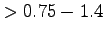 /p Flow Rate /p Flow Rate  p/min/m.
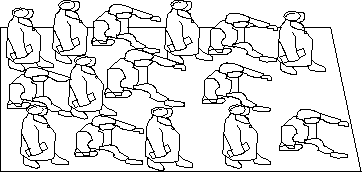
At LOS E, virtually all pedestrians restrict their normal walking speed,
frequently adjusting their gait.
At the lower range, forward movement is possible only by shuffling.
Space is not sufficient for passing slower pedestrians.
Cross- or reverse-flow movements are possible only with extreme difficulties.
Design volumes approach the limit of walkway capacity, with stoppages and
interruptions to flow.
It is shown in Fig. 5. p/min/m.
At LOS E, virtually all pedestrians restrict their normal walking speed,
frequently adjusting their gait.
At the lower range, forward movement is possible only by shuffling.
Space is not sufficient for passing slower pedestrians.
Cross- or reverse-flow movements are possible only with extreme difficulties.
Design volumes approach the limit of walkway capacity, with stoppages and
interruptions to flow.
It is shown in Fig. 5.
Figure 5:
LOS E
 |
Pedestrian Space  /p Flow Rate varies p/min/m.
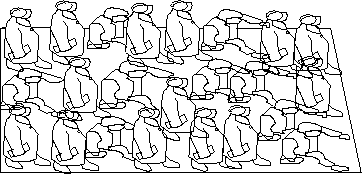
At LOS F, all walking speeds are severely restricted, and forward progress is
made only by shuffling.
There is frequent, unavoidable contact with other pedestrians.
Cross- and reverse-flow movements are virtually impossible.
Flow is sporadic and unstable.
Space is more characteristic of queued pedestrians than of moving pedestrian
streams.
It is shown in Fig. 6. /p Flow Rate varies p/min/m.
At LOS F, all walking speeds are severely restricted, and forward progress is
made only by shuffling.
There is frequent, unavoidable contact with other pedestrians.
Cross- and reverse-flow movements are virtually impossible.
Flow is sporadic and unstable.
Space is more characteristic of queued pedestrians than of moving pedestrian
streams.
It is shown in Fig. 6.
Figure 6:
LOS F
 |
|
|
| | |
|
|
|


