| |
| | |
|
Average Pedestrian Space   /p.
Standing and free circulation through the queuing area is possible without
disturbing others within the queue.
Average Pedestrian Space /p.
Standing and free circulation through the queuing area is possible without
disturbing others within the queue.
Average Pedestrian Space  / p.
Standing and partially restricted circulation to avoid disturbing others in the
queue is possible.
Average Pedestrian Space / p.
Standing and partially restricted circulation to avoid disturbing others in the
queue is possible.
Average Pedestrian Space  /p.
Standing and restricted circulation through the queuing area by disturbing
others in the queue is possible; this density is within the range of personal
comfort.
Average Pedestrian Space /p.
Standing and restricted circulation through the queuing area by disturbing
others in the queue is possible; this density is within the range of personal
comfort.
Average Pedestrian Space  /p.
Standing without touching is possible; circulation is severely restricted within
the queue and forward movement is only possible as a group; long-term waiting at
this density is uncomfortable.
Average Pedestrian Space /p.
Standing without touching is possible; circulation is severely restricted within
the queue and forward movement is only possible as a group; long-term waiting at
this density is uncomfortable.
Average Pedestrian Space  /p.
Standing in physical contact with others is unavoidable; circulation in the
queue is not possible; queuing can only be sustained for a short period without
serious discomfort.
Average Pedestrian Space /p.
Standing in physical contact with others is unavoidable; circulation in the
queue is not possible; queuing can only be sustained for a short period without
serious discomfort.
Average Pedestrian Space  /p.
Virtually all persons within the queue are standing in direct physical contact
with others; this density is extremely uncomfortable; no movement is possible in
the queue; there is potential for panic in large crowds at this density.
The signalized intersection crossing is more complicated to analyze than a
mid-block crossing, because it involves intersecting sidewalk flows, pedestrians
crossing the street, and others queued waiting for the signal to change.
The service measure is the average delay experienced by a pedestrian.
Research indicates that the average delay of pedestrians at signalized
intersection crossings is not constrained by capacity, even when pedestrian flow
rates reach 5,000 p/h.
The average delay per pedestrian for a crosswalk is given by Equation: /p.
Virtually all persons within the queue are standing in direct physical contact
with others; this density is extremely uncomfortable; no movement is possible in
the queue; there is potential for panic in large crowds at this density.
The signalized intersection crossing is more complicated to analyze than a
mid-block crossing, because it involves intersecting sidewalk flows, pedestrians
crossing the street, and others queued waiting for the signal to change.
The service measure is the average delay experienced by a pedestrian.
Research indicates that the average delay of pedestrians at signalized
intersection crossings is not constrained by capacity, even when pedestrian flow
rates reach 5,000 p/h.
The average delay per pedestrian for a crosswalk is given by Equation:
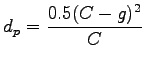 |
(1) |
Where,
 = average pedestrian delay (s),
g = effective green time (for pedestrians) (s), and
C= cycle length (s). = average pedestrian delay (s),
g = effective green time (for pedestrians) (s), and
C= cycle length (s).
Table 1:
LOS Criteria For Pedestrians At Signalized Intersections
| LOS |
Pedestrian Delay(s/p) |
Likelihood of |
| |
|
Noncompliance |
| A |
 |
Low |
| B |
 |
|
| C |
 |
Moderate |
| D |
 |
|
| E |
 |
High |
| F |
 |
Very high |
Calculate time delay of pedestrian crossing at a signalized intersection
operating on a two phase, 80.0-s cycle length, with 4.0-s change interval, and
no pedestrian signals.
Major street:
Phase green time, Gd = 44.0 s;
Crosswalk length, Ld = 14.0 m;
Minor street:
Crosswalk length, Lc = 8.5 m;
Phase green time, Gc = 28.0 s;
dp = /2c,
dp (major) = (80.0 - 28.0)* (80.0 - 28.0)/2(80),
= 16.9 s (i.e. LOS B using above table),
dp (minor) = (80.0 - 44.0)* (80.0 - 44.0)/2(80)
= 8.1 s (i.e. LOS A using above table). /2c,
dp (major) = (80.0 - 28.0)* (80.0 - 28.0)/2(80),
= 16.9 s (i.e. LOS B using above table),
dp (minor) = (80.0 - 44.0)* (80.0 - 44.0)/2(80)
= 8.1 s (i.e. LOS A using above table).
|
|
| | |
|
|
|


