| |
| | |
|
In the design facilities we will discuss the design criteria of sidewalk, street
corner, crosswalk, traffic island, overpass and underpass and other facilities
like as pedestrian signals and signage.
Sidewalks are pedestrian lanes that provide people with space to travel
within the public right-of-way that is separated from roadway vehicles.
They also provide places for children to walk, run, skate, ride bikes, and play.
Sidewalks are associated with significant reductions in pedestrian collisions
with motor vehicles.
- Width:
The minimum clear width of a pedestrian access route shall be 1220 mm exclusive
of the width of curb.
It varies according to pedestrian flow rate and different LOS.
It is shown in following Table.
Table 1:
Minimum pedestrian clear area (excluding sidewalk obstructions)
| Pedestrian Flow rate |
LOS A |
LOS B |
LOS C |
LOS D |
LOS E |
| (pedestrian/hour) |
|
|
|
|
|
 |
1.5 m |
1.2 m |
1.2 m |
1.2 m |
1.2 m |
| 600-1200 |
3.1 m |
1.2 m |
1.2 m |
1.2 m |
1.2 m |
| 1200-2400 |
6.1m |
1.8 m |
1.5 m |
1.2 m |
1.2 m |
| 2400-3600 |
|
2.8 m |
1.8 m |
1.5 m |
1.2 m |
| 3600-4800 |
|
3.7 m |
2.5 m |
1.8 m |
1.2 m |
| 4800-6000 |
|
4.6 m |
3.1 m |
2.1 m |
1.2 m |
| 6000-7200 |
Not |
5.5 m |
3.7 m |
2.5 m |
1.5 m |
| 7200-8400 |
recommended |
6.1 m |
4.3 m |
3.1 m |
1.8 m |
| 8400-9600 |
|
7.1 m |
4.9 m |
3.4 m |
2.1 m |
| 9600-10800 |
|
8.1 m |
5.5 m |
3.7 m |
2.5 m |
| 10800-12000 |
|
8.9 m |
6.1 m |
4.3 m |
2.5 m |
- Cross slope:
The cross slope of the pedestrian access route shall be maximum 1:48.
- Surfaces:
Surface should be firm, stable, slip resistance and prohibit openings & avoid
service elements i.e. manholes etc.
A buffer zone of 1.2 to 1.8 m (4 to 6 ft) is desirable and should be provided to
separate pedestrians from the street.
The buffer zone will vary according to the street type.
In downtown or commercial districts, a street furniture zone is usually
appropriate.
Marked crosswalks indicate optimal or preferred locations for pedestrians to
cross and help designate right-of-way for motorists to yield to pedestrians.
Crosswalks are often installed at signalized intersections and other selected
locations.
- It should be located at all open legs of signalized intersection.
- It should be perpendicular to roadway.
- The parallel line should be 0.2-0.6 m in width and min. length 1.8 m
(standard 3m).
- Marking may be of different type to increase visibility like as solid,
standard, continental, dashed, zebra, ladder.
It is shown in Fig. 1.
Figure 1:
Cross walk marking pattern
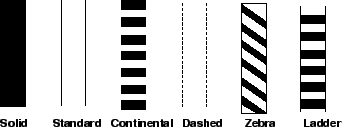 |
Figure 2:
Ladder pattern at intersection
 |
|
|
| | |
|
|
|


