| |
| | |
|
If the mean and standard deviation of certain observed set of headways is 2.25
and 0.875 respectively, then compute the probability that the headway lies in
an interval of 1.5 to 2.0 seconds.
The probability that headway lies between 1.5 and 2.0 can be obtained using
equation ![[*]](file:/usr/local/share/lib/latex2html/icons/crossref.png) , given that , given that  and and
 as: as:
Note that the
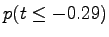 and and
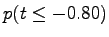 are obtained from the
standard normal distribution tables.
Since the normal distribution is defined from are obtained from the
standard normal distribution tables.
Since the normal distribution is defined from  to to  unlike an
exponential distribution which is defined only for positive number, it is
possible that normal distribution may generate negative headways.
A practical way of avoiding this is to shift the distribution by some value so
that it will mostly generate realistic headways.
The concept is illustrated in figure 1. unlike an
exponential distribution which is defined only for positive number, it is
possible that normal distribution may generate negative headways.
A practical way of avoiding this is to shift the distribution by some value so
that it will mostly generate realistic headways.
The concept is illustrated in figure 1.
Figure 1:
Normal Distribution
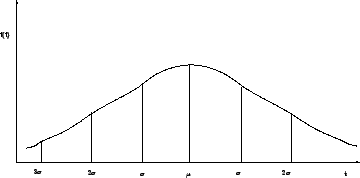 |
Suppose  is the minimum possible headway and if we set is the minimum possible headway and if we set
 than about 60% of headway will be greater than .
Alternatively, if we set than about 60% of headway will be greater than .
Alternatively, if we set
 , than about 90% of the headway
will be greater than .
Further, if we set , than about 90% of the headway
will be greater than .
Further, if we set
 , than about 99% of the headway will be
greater than .
To generalize, , than about 99% of the headway will be
greater than .
To generalize,
where n is 1, 2, 3, etc and higher the value of  , then is better the
precision.
From this equation, we can compute the value of , then is better the
precision.
From this equation, we can compute the value of  to be used in normal
distribution calculation when the random variable cannot be negative as: to be used in normal
distribution calculation when the random variable cannot be negative as:
|
|
| | |
|
|
|


![$\displaystyle p[1.5\le t\le 2.0]$](img3.png)

![$\displaystyle p[t\le 2.0]-p[t\le 1.5]$](img5.png)
![$\displaystyle p\left[t\le \frac{2.0-2.25}{0.875}\right] - p\left[t\le
\frac{1.5-2.25}{0.875}\right]$](img6.png)
![$\displaystyle p\left[t\le -0.29 \right] - p\left[t\le -0.86 \right]$](img7.png)



