The probability density function of the normal distribution is given by:
(1)
where is the mean of the headway and is the standard deviation
of the headways.
The shape of the probability density function is shown in
figure 1.
Figure 1:
Shape of normal distribution curve
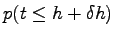
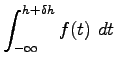
The probability that the time headway (t) less than a given time headway (h) is
given by
(2)
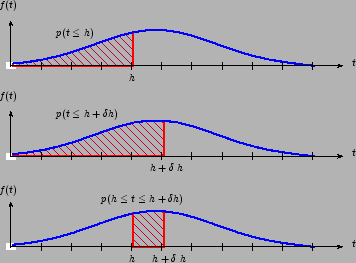
and the value of this is shown as the area under the curve in
figure 2 (a) and the probability of time headway (t) less than a
given time headway (
) is given by
(3)
This is shown as the area under the curve in figure 2 (b).
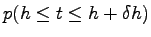
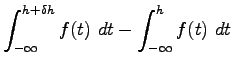
Hence, the probability that the time headway lies in an interval, say and
is given by
(4)
This is illustrated as the area under the curve in figure 2 (c).
Figure 2:
Illustration of the expression for probability that the random
variable lies in an interval for normal distribution
Although the probability for headway for an interval can be computed easily
using equation 4, there is no closed form solution to the
equation 2.
Eventhough it is possible to solve the above equation by numerical integration,
the computations are time consuming for regular applications.
One way to overcome this difficulty is to use the standard normal distribution
table which gives the solution to the equation 2 for a standard
normal distribution.
A standard normal distribution is normal distribution of a random variable
whose mean is zero and standard deviation is one.
The probability for any random variable, having a mean () and standard
deviation () can be computed by normalizing that random variable with
respect to its mean and standard deviation and then use the standard normal
distribution table.
This is based on the concept of normalizing any normal distribution based on the assumption that if t follows normal distribution with mean and standard deviation , then
follows a standard normal distribution having zero mean and unit standard deviation.
The normalization steps shown below.
(5)
The first and second term in this equation be obtained from standard normal
distribution table.
The following example illustrates this procedure.



 is the mean of the headway and
  is the standard deviation
of the headways.
The shape of the probability density function is shown in
figure
is the standard deviation
of the headways.
The shape of the probability density function is shown in
figure 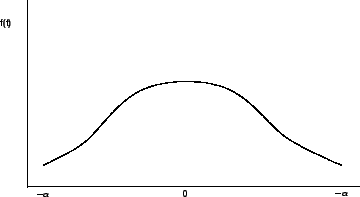


 ) is given by
 and
and

 follows a standard normal distribution having zero mean and unit standard deviation.
The normalization steps shown below.
follows a standard normal distribution having zero mean and unit standard deviation.
The normalization steps shown below.
![$\displaystyle p[h\le t\le (h+\delta h)]$](img17.png)
![$\displaystyle p\left[\frac{h-\mu}{\sigma}\le
\frac{t-\mu}{\sigma}\le \frac{(h+\delta h)-\mu}{\sigma}\right]$](img18.png)
![$\displaystyle p\left[t\le \frac{(h+\delta h)-\mu}{\sigma}\right] - p\left[t\le
\frac{h-\mu}{\sigma}\right]$](img19.png)