| |
| | |
|
An important parameter to characterize the traffic is to model the
inter-arrival time of vehicle at a section on the road.
The inter-arrival time or the time headway is not constant due to the
stochastic nature of vehicle arrival.
A common way of modeling to treat the inter-arrival time or the time headway as
a random variable and use some mathematical distributions to model them.
The behavior of vehicle arrival is different at different flow condition.
It may be possible that different distributions may work better at different
flow conditions.
Suppose the vehicle arrive at a point at time
 .
Then the time difference between two consecutive arrivals is defined as
headway.
This is shown as a time-distance diagram in figure 1. .
Then the time difference between two consecutive arrivals is defined as
headway.
This is shown as a time-distance diagram in figure 1.
Figure 1:
Illustration of headways
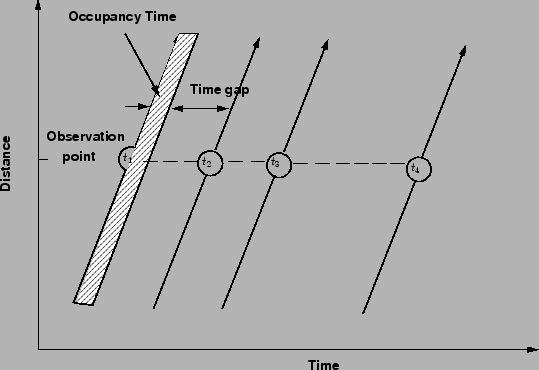 |
In fact the headway consist of two components, the occupancy time which is the
duration required for the vehicle to pass the observation point and the time
gap between the rear of the lead vehicle and front of the following vehicle.
Hence, the headways
 It may be noted that the headways
 will not be constant, but
follows some random distribution.
Further, under various traffic states, different distribution may best explain
the arrival pattern.
A brief discussion of the various traffic states and suitable distributions are
discussed next. will not be constant, but
follows some random distribution.
Further, under various traffic states, different distribution may best explain
the arrival pattern.
A brief discussion of the various traffic states and suitable distributions are
discussed next.
|
|
| | |
|
|
|


