| |
| | |
|
Using the spot speed data given in the following table, collected from a
freeway site operating under free-flow conditions:
(i) Plot the frequency and cumulative frequency curves for these data;
(ii) Obtain median speed, modal speed, pace, and percent vehicles in pace from these plots;
(iii) Compute the mean and standard deviation of the speed distribution;
(iv) The confidence bounds on the estimate of the true mean speed of the underlying distribution with 95% confidence? With 99.7% confidence; and
(v) Based on these results, compute the sample size needed to achieve a tolerance of  kmph with 95% confidence. kmph with 95% confidence.
| Speed Range |
Frequency  |
| 21-25 |
2 |
| 26-30 |
6 |
| 31-35 |
18 |
| 36-40 |
25 |
| 41-45 |
19 |
| 46-50 |
16 |
| 51-55 |
17 |
| 56-60 |
12 |
| 61-65 |
7 |
| 66-70 |
4 |
| 71-75 |
3 |
| 76-80 |
1 |
For the spot speed study, first draw a frequency distribution table show below.
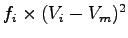
- From the table 6.3, we can draw frequency distribution and cumulative
frequency distribution curve.(shown in Fig 6.6 and 6.7)
Table 1:
Solution of the example problem
| Speed Range |
Mid speed  |
Frequency |
% |
 |
 |
 |
| 21-25 |
23 |
2 |
2% |
2% |
46 |
1036.876 |
| 26-30 |
28 |
6 |
5% |
6% |
168 |
1894.473 |
| 31-35 |
33 |
18 |
14% |
20% |
594 |
2934.959 |
| 36-40 |
38 |
25 |
19% |
39% |
950 |
1509.024 |
| 41-45 |
43 |
19 |
15% |
54% |
817 |
145.7041 |
| 46-50 |
48 |
16 |
12% |
66% |
768 |
79.6213 |
| 51-55 |
53 |
17 |
13% |
79% |
901 |
888.8284 |
| 56-60 |
58 |
12 |
9% |
88% |
696 |
1795.101 |
| 61-65 |
63 |
7 |
5% |
94% |
441 |
2078.296 |
| 66-70 |
68 |
4 |
3% |
97% |
272 |
1976.828 |
| 71-75 |
73 |
3 |
2% |
99% |
219 |
2224.544 |
| 76-80 |
78 |
1 |
1% |
100% |
78 |
1038.822 |
| Total |
|
130 |
100% |
|
5950 |
17603.08 |
|
- From the curves,
Median speed,
 = 43 kmph;
Modal speed, = 38 kmph;
the Pace = 33 - 43 kmph;
Percent vehicles in pace = 54-20= 34%; and the
85th Percentile speed = 58 kmph. = 43 kmph;
Modal speed, = 38 kmph;
the Pace = 33 - 43 kmph;
Percent vehicles in pace = 54-20= 34%; and the
85th Percentile speed = 58 kmph.
Figure 1:
Frequency Distribution Curve
Figure 2:
Cumulative Frequency Distribution Curve
|
|
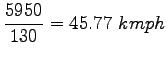
- Mean is calculated by using
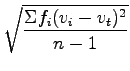
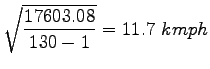
Standard Deviation of the Speed
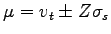
- The confidence bounds on the estimate of the true mean speed of the
underlying distribution are:
- For 95% confidence, Z= 1.96, so
- For 99.7% confidence, Z= 3.0, so
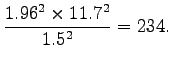
- Sample size required for 95% confidence with acceptable error of 1.5
kmph
So, given sample size is not sufficient and we require minimum 234 samples to
achieve that confidence with given acceptable error.
The results are summaries in table 0.1
Table 2:
Result of the example problem
| Parameter |
Value |
| Median speed |
43 kmph |
| Modal speed |
38 kmph |
| Pace |
33-43 kmph |
| Vehicles in pace |
34% |
| Mean speed |
45.77 kmph |
| Standard Deviation |
11.7 kmph |
| 85th percentile speed |
58 kmph |
| 15th percentile speed |
32 kmph |
| 98th percentile Speed |
72 kmph |
| Confidence interval |
|
|---|
| For 95%. |
45.77±22.93 kmph |
| For 99.7% |
45.77±±25.1 kmph |
| Required sample Size |
234 |
|
|
|
| | |
|
|
|


![\includegraphics[height = 5cm]{qffrequencycurve}](img8.png)
![\includegraphics[height = 5cm]{qfcfrequencycurve}](img9.png)