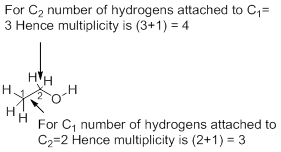
• The true spectrum has a pair of doublets each split by an identical amount. It is to be noted that no line appears at the true chemical shift, but it is easy to measure the chemical shift by taking the midpoint of the doublet. The multiplicity (splitting of peaks) can be determined by counting the protons on the carbons attached immediately to carbon to which the referred proton is attached and using the formula n+1. Thus for the CH3 group in ethanol, there is a CH2 group attached to it hence the formula gives (2+1) or 3 as multiplicity.
 |
• As for the ppm scale, the exact frequency at which the nucleus resonates depends on the external applied magnetic field. This means that, if the sample is run on a machine with a different magnetic field, it will resonate at a different frequency. It would be very difficult if as it couldn't be said exactly where the signal was, so instead how far it is from some reference sample, as a fraction of the operating frequency of the machine is mentioned. All protons resonate at approximately the same frequency in a given magnetic field and that the exact frequency depends on what sort of chemical environment it is in, which in turn depends on its electrons. This approximate frequency is the operating frequency of the machine and simply depends on the strength of the magnet—the stronger the magnet, the larger the operating frequency. The precise value of the operating frequency is simply the frequency at which a standard reference sample resonates. In everyday use, rather than actually referring to the strength of the magnet in tesla, chemists usually just refer to its operating frequency. A 9.4 T NMR machine is referred to as a 400 MHz spectrometer since that is the frequency in this strength field at which the protons in the reference sample resonate; other nuclei, for example 13C, would resonate at a different frequency, but the strength is arbitrarily quoted in terms of the proton operating frequency. The compound we use as a reference sample is usually tetramethylsilane, TMS. The four carbon atoms attached to silicon are all equivalent and, because silicon is more electropositive than carbon, are fairly electron-rich (or shielded), which means they resonate at a frequency a little less than that of most organic compounds. The chemical shift, δ, in parts per million (ppm) of a given nucleus in our sample is defined in terms of the resonance frequency as:
 |
• No matter what the operating frequency (i.e. strength of the magnet) of the NMR machine, the signals in a given sample (e.g. ethanol) will always occur at the same chemical shifts. In ethanol the carbon attached to the OH resonates at 3.56 ppm whilst the carbon of the methyl group resonates at 0.98 ppm. By definition TMS itself resonates at 0 ppm. The proton nuclei in most organic compounds resonate at greater chemical shifts, normally between 0 and 10 ppm. Similarly, the carbon nuclei in most organic compounds resonate at greater chemical shifts, normally between 0 and 200 ppm.