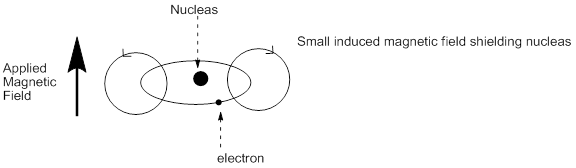
In the spectrum, each line represents a different kind of carbon atom: each one absorbs energy (or resonates—hence the term nuclear magnetic resonance) at a different frequency. The reason that each carbon does not feel the same magnetic field is because of the electronic cloud around them. Each nucleus is surrounded by electrons, and in a magnetic field these will set up a tiny electric current. This current will set up its own magnetic field (rather like the magnetic field set up by the electrons of an electric current moving through a coil of wire or solenoid), which will oppose the magnetic field that is applied. The electrons are said to shield the nucleus from the external magnetic field. If the electron distribution varies from 13C atom to 13C atom, so does the local magnetic field, and so does the resonating frequency of the 13C nuclei. A change in electron density at a carbon atom also alters the chemistry of that carbon atom. NMR tells us about the chemistry of a molecule as well as about its structure.
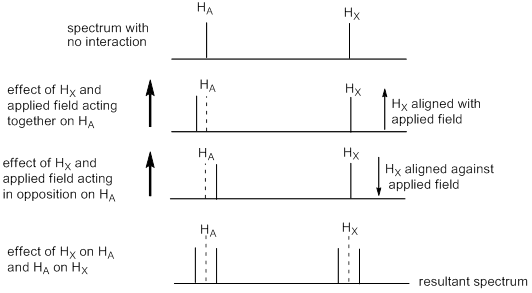
In the spectrum above, the peak centred on 1ppm is for the CH3 protons, the next are for CH2 protons and the peak at around 5 ppm is for the OH proton. There are two things to be noted, the first is the so called “ppm” scale and second one is the splitting of the peaks in the proton signals. The splitting of the signal is due to coupling of the nuclear spins of one atom with another. An explanation can be provided for this phenomenon. If a molecule has two types of proton HA and HX having no interaction between them, then they can be aligned either along the external magnetic field or against it and only two lines are obtained. This can be seen 4,6-diaminopyrimidine-where there are only two single lines (called singlets). However, if there is an interaction between the two types of protons, then a different scenario arises. Now each proton, say, HA , is near enough to experience the small magnetic field of the other proton HX as well as the field of the magnet itself. The diagram shows the result.