Factors influencing the siting
- Drainage: Rapid runoff will lessen mosquito problems, but proximity to streams or well supplies may result in water pollution.
- Wind: It is preferable that the landfill be downwind from any nearby community.
- Distance from collection sites.
- Size: A small site with limited capacity is generally not acceptable since finding a new site entails considerable difficulty.
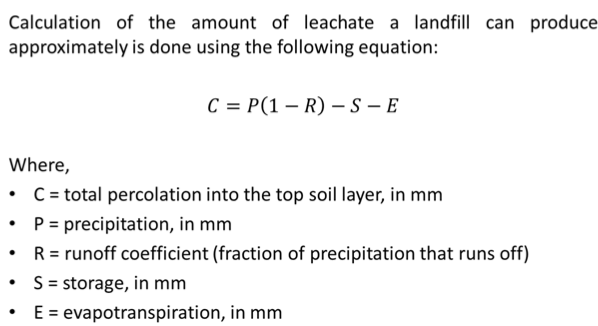
- Rainfall patterns influence the production of leachate from the landfill.
- Soil must be used as cover so soil type is an important factor.
- Depth of the water table: The bottom of the landfill must be substantially above the highest expected groundwater elevation.
- Treatment of leachate requires proximity to wastewater treatment facilities.
- All landfills attract birds to some extent and are therefore not compatible with airports in vicinity.
- The final use of the land has to considered before undertaking the project.
Byproducts of landfilling
- During the operational period and even afterwards there is always a cost of maintenance involved to monitor the environmental impact and mitigate it accordingly and within laws of the state. The environmental impact is mainly caused due to the byproducts of the landfills.
- There are mainly two types of byproducts
–Leachate
–Gases
Leachate
- The liquid produced during decomposition, as well as water that seeps through the groundcover and works its way out of the refuse, is known as leachate.
- This liquid contains pollutants in high concentration.
- If the leachate escapes the landfill, its effects on the environment are severe. In a number of instances, leachate has polluted nearby wells to a degree that they have ceased to be sources of potable water.
- Leachate production depends on rainfall patterns as well as on total amount of precipitation.