Sanitary landfills
- Sanitary landfills are engineered operations, designed and operated according to acceptable standards as opposed to open dumps which are simply places to deposit waste.
- Sanitary landfilling is the compaction of refuse in a lined pit and the covering of the compacted refuse with an earthen cover.
- A landfill continues to subside after closure, so that permanent structures cannot be built onsite without special foundations.
- Closed landfills have potential uses as golf courses, playgrounds, tennis courts, winter recreation, or parks and green belts.
- The sanitary landfilling operation involves numerous stages, including siting, design, operation, and closing.
Process of landfilling
- The liner is made of plastic and a layer of clay that further reduces the chance of leakage into the groundwater of the liquid produced by the landfill during the decomposition of the waste.
- The liquid produced is collected by pipes laid into the landfill as it is constructed.
- Gases produced by the decomposing waste must be collected and either vented or collected and burned.
- When the landfill is full, a cover must be placed on it such that the seepage of rainwater into the landfill is minimized.
- Vegetation must then be established on the landfill, and its effect on groundwater must be monitored by wells sunk around it.
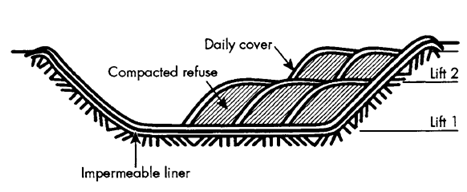
- Refuse is unloaded, compacted with bulldozers, and covered with compacted soil.
- The landfill is built up in units called cells.
- The daily cover is between 6 and 12 inches thick depending on soil composition.
- The final cover of at least 2 feet thick is used to close the landfill.