1.4. Design problem
The above design procedure is elaborated through the calculation of the following exampleProblem Statement:
150000 lb per hour of kerosene will be heated from 75 to 120°F by cooling a gasoline stream from 160 to 120°F. Inlet pressure will be 50 psia for each stream and the maximum pressure drop of 7 psi for gasoline and 10 psi for kerosene are permissible. Published fouling factors for oil refinery streams should be used for this application. Design a shell and tube heat exchanger for this service.
Part 1: Thermal design :
( Part 2: Mechanical design provided in module #4 )
Given data :
Hot fluid inlet temperature (T1)= 160°F
Hot fluid outlet temperature (T2) = 120°F
Cold fluid inlet temperature (t1) = 75°F
Cold fluid outlet temperature (t2) = 120°F
Fouling factor of hot fluid (Rdg) = 0.0005 (for gasoline)
Fouling factor of cold fluid (Rdk) = 0.001 (for kerosene)
Pinlet (for hot fluid) = 50 psia
Pinlet (for cold fluid) = 50 psia
ΔPmax (for cold fluid) = 7 psia
ΔPmax (for cold fluid) = 10 psia
Mass flow rate of cold fluid (  ) = 150000 lb.h-1
(Subscripts ‘k' for kerosene and ‘g ' for gasoline)
I. Calculation of calorific temperature
For the calculation of calorific temperature please refer [3] (page 827) .
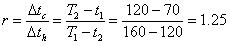
° API of hot fluid=76° ; Therefore Kc = 1; Fc = 0.456
(The calorific temperature factor, Fc with ° API as a function Kc is available in reference [3] (page 827) .
Calorific temperature of the hot fluid, 
=120+0.455×(160-120)
=138.2°F
Calorific temperature of the cold fluid, 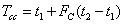
=75+0.455×(120-75)
=95.475°F