Effect of internal mass transport on catalytic reaction rate
Diffusion
Diffusion of reactants within pores is a complex phenomena and results from the contribution of:
1. Bulk diffusion: Diffusion due to concentration or pressure gradients. The molecules collide with each other.
2. Knudsen diffusion: Diffusion in fine pores governed by molecular velocity and as well as diameter of pore. The diffusing molecule is more likely to collide with a wall rather than another molecule. It is important at low pressures and for pore size below 50 nm.
3. Surface diffusion: Transport of adsorbed molecules on a surface by hopping mechanism that is adsorbed molecules tend to migrate to an adjacent empty site if it has sufficient energies to jump or overcome the energy barrier. However, in most cases contribution of surface diffusion to total transport is very small and generally neglected.
For macroporous material with large pore size such as alumina pellets of mean radius of 8000 A0, bulk diffusion would prevail in these pores at atmospheric pressure. As the size of the pore decreases, diffusion in the pores is more and more influenced by pore walls and transport is dominated by Knudsen mechanism. Hence in micropores, particularly for gaseous system, transport can be assumed to be entirely by Knudsen diffusion.
The pressure also affects the relative contribution of bulk and Knudsen diffusion for gaseous system. The mean free path is inversely proportional to pressure. Increase in pressure decreases mean free path and probability of collision between molecules increases. Consequently, bulk diffusivity becomes more important as the pressure is increased. On the other hand, as pressure is lowered mean free path is reduced and probability of molecules colliding with the walls is increased. Consequently, transport is dominated by Knudsen diffusion.
The diffusion in binary system is represented by Fick's law which states that molar flux of a species relative to an observer moving with molar average velocity is proportional to the concentration gradient of the species. If A diffuses in a binary mixture of A and B, then according to Fick's law the flux of A is expressed as 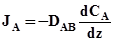 Here DAB is the proportionality constant called the diffusion coefficient or diffusivity of A in mixture of A and B.
Different binary diffusion conditions may exists:
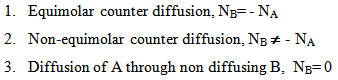
Here NA, and NB are the molar flux of A and B respectively. The negative sign correspond to opposite direction.