Linear and nonlinear regression of rate data
For a Langmuir –Hinshelwood type rate equation
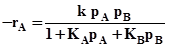 , the value of rate law parameters k, KA, KB cannot be analyzed as simply as in power law kinetics. The rate law parameters can be determined by linear least square or nonlinear least square method. In linear least square method, the above LH rate equation can be linearized by dividing throughout by pA and pB and inverting it as shown below:
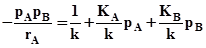
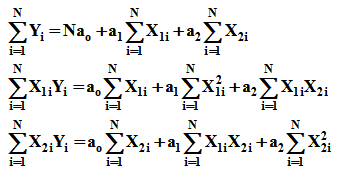
The parameters can be estimated by multiple regression technique using the following equation for N experimental runs. For the ith run:

The best values of the parameters a0 , a1 and a2 are found by solving following three equations
The above LH rate equation can also be solved by non-linear regression analysis. Usually linearized least square analysis is used to obtain the initial estimates of the rate parameters and used in non-linear regression. In non linear analysis the rate law parameters are first estimated to calculate the rate of reaction ‘rc'. Then the values of rate law parameters that will minimize the sum of the squares of difference of the measured reaction rate rm and the calculated reaction rate rc, that is the sum of (rm -rc)2 for all data points, are searched. If there are N experiments with K number of parameter values to be determined then the function to be minimized is given by 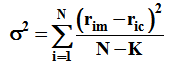
Here rim and ric are the measured and calculated reaction rate for ‘i'th run respectively. The parameter values giving the minimum of the sum of squares,  , can be searched by various optimization techniques using software packages.