Resolution
Atomic force microscopes can provide resolutions comparable to or even better than those obtained with electron microscopes. As images are not obtained using light or particles (such as electrons), resolution of AFM does not depend on any wavelength. The resolution of an AFM is determined by the diameter and the geometry of the probe. The influence the probe
dimensions
on the resolution is diagrammatically represented in figure 36.3.
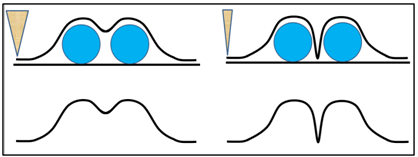
Figure 36.3 Effect of tip dimensions on the lateral resolution of an AFM.
It is evident that the resolution in the X-Y plane is poor and strongly depends on the probe dimensions. Resolution in Z- dimension (height), on the other hand, is very high; resolutions of ~0.2 nm or better are routinely achieved using high-resolution tips.
It is evident that the resolution in the X-Y plane is poor and strongly depends on the probe dimensions. Resolution in Z-resolution (height), on the other hand, is very high; resolutions of ~0.2 nm or better are routinely achieved using high-resolution tips.
Materials
Equipments:
1. An atomic force microscope
2. Weighing balance
Reagents:
1. The peptide, diphenylalanine (NH2-Phe-Phe-COOH)
a. Diphenylalanine (NH2 -Phe-Phe-COOH) is a dipeptide that readily assembles into highly ordered nanotubes in aqueous solutions.
2. 1,1,1,3,3,3 hexafluoro-2-propanol (HFIP)
Other materials:
- Pipettes
- Pipette tips
- 1.5 ml microfuge tubes
- V1 grade mica sheet