High Pressure Liquid Chromatography: Pressure limit more than 50-350 bar. A typical polysaccharide bead is not appropriate to withstand high pressure during HPLC. Hence, in HPLC silica based beads are recommended. Due to high pressure and smaller size of the silica beads gives higher number of theoretical plates. This gives HPLC superior resolving power to separate complex biological samples.
3. Mixer: A mixer is required to mix the buffer received from both pumps to form a linear or step gradient.
4. Column: A column made up of glass or steel.
5. Detector: The elution coming out from column goes to the online monitoring system to test the presence of the analyte based on different properties. There are different types of detectors are known in chromatography such as UV-Visible detector etc.
6. Fraction Collection- The eluent can be collected in different fractions by a fraction collector.
7. Recorder: The profile of eluent with respect to the measured property in a detector can be plotted in the recorder.
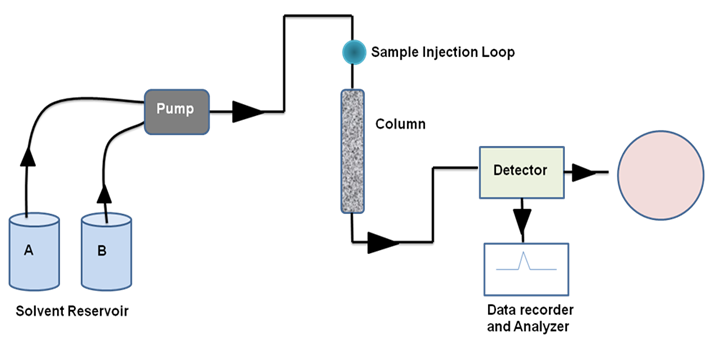 Figure 28.6: Different components of a chromatography system.
Different forms of chromatography:
Partition Chromatography: In this form of chromatography, an analyte distribute themselves into two phases, liquid stationary and mobile phase. The major advantage of this chromatography is that it is simple, low cost and has broad specificity. It is further divided into liquid-liquid chromatography and bonded-phase liquid chromatography. The example of this chromatography is cellulose, starch or silica matrix.
Adsorption Chromatography: In this form of chromatography, matrix molecule has ability to hold the analyte on their surface through a mutual interaction due to different types of forces such as hydrogen bonding, electrostatic interaction, vander waal etc. The example are ion-exchange chromatography, hydrophobic interaction chromatography, affinity chromatography etc.