Similarly one can also exploit other physical & chemical parameters as well. With each and every physical and chemical parameter the molecule present in the mixture will distribute as per their behavior in each parameter.
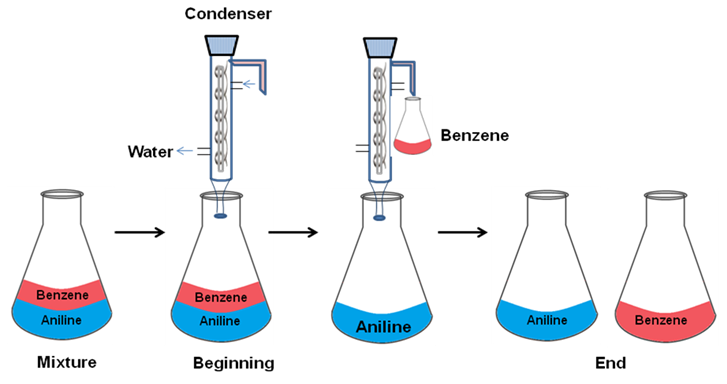
Figure 28.2: Distribution of molecules during distillation.
Chromatography: The purpose of chromatography is to separate a complex mixture into individual component exploiting the partition effect which distribute the molecules into the different phases. As discussed above, a distribution of a molecule between two phases A and B is given by a distribution coefficient, Kd. In most of the chromatography techniques, phase A is stationary phase or matrix and phase B is mobile phase or buffer.
Column Chromatography: In column chromatography, a stationary phase is filled into a cylindrical tube made up of glasss or steel. The mixture of analyte is loaded on the top and it runs from top to bottom. How Kd is exploited in column chromatography ? Assume two molecules, X and Y with a Kd value of 1 and 9 and they are traveling through a column with water as mobile phase as given in Figure 28.3. As they will travel, X and Y will partition between stationary phase and mobile phase. As there is a huge difference in Kd, Y will be associated with the matrix and remain on the top of the column where as X will move along the water. At the end of chromatography, X will come out first whereas Y will come out last.