8. Production of synthetic seeds or artificial seed
Although it is possible to use naked embryos for large scale planting, it would be beneficial to convert them into ‘synthetic seeds' or ‘synseeds' for large scale clonal propagation at commercial level. This can be achieved by encapsulating the viable somatic embryos in a protective covering. The coating material should have several qualities:
- i. It must be non-damaging to the embryos.
ii. The coating should be mild enough to protect the embryos and allow germination but it must be sufficiently durable for rough handling during manufacture, storage, transportation and planting.
iii. The coat must contain nutrients, growth regulators and other components necessary for germination.
iv. The quality of somatic embryo should be good enough, they all are of uniform stage with reversible arrested growth and with high rate of conversion to plantlets.
Two types of synthetic seeds are produced:
I. Desiccated synthetic seeds II. Hydrated synthetic seeds
I. Desiccated synthetic seeds : It involves encapsulation of somatic embryos followed by their desiccation and can be prepared by following methodology:
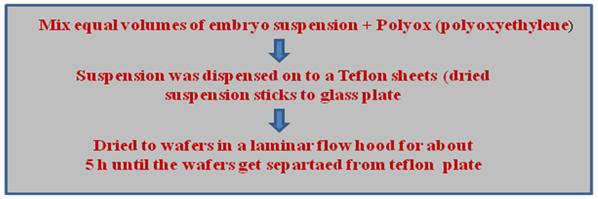
The polyox is readily soluble in water and dries to thin film. It does not support the growth of microorganism and is non toxic to the embryos. Embryo survival and conversion of seeds are determined by redissolving the wafers in embryogenic medium and culturing the rehydrated embryos.
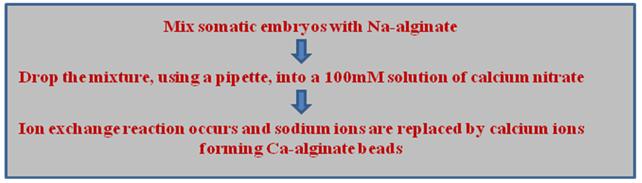
II. Hydrated synthetic seed: Several methods have been examined to produce hydrated artificial seeds of which Ca-alginate encapsulation has been the most widely used. It can be prepared by following steps:
9. Applications of somatic embryogenesis
Following features of somatic embryos prompted many scientists to achieve regeneration via somatic embryogenesis using various explants, most popular ones being zygotic embryos, or excised cotyledons or hypocotyls
- i. Somatic embryogenesis offers immense potential to speed up the clonal propagation of plants being bipolar in nature.
ii. Being single cell in origin, there is a possibility to automate large scale production of embryos in bioreactors and their field planting as synthetic seeds.
iii. The bipolar nature of embryos allows their direct development into complete plantlet without the need of a rooting stage as required for plant regeneration via organogenesis.
iv. Epidermal single cell origins of embryos favor the use of this process for plant transformation.
v. It can also be used for the production of metabolites in species where embryos are the reservoir of important biochemical compounds.
vi. The production of artificial seeds using somatic embryos is an obvious choice for efficient transport and storage.
vii. The embryo culture technique is applied to overcome embryo abortion, seed dormancy and self-sterility in plants.
10. Limitations of somatic embryogenesis
- i. Complete conversion into plantlets or poor germination of embryos is a major limitation of somatic embryogenesis in many plants. Therefore, the process of germination needs to be studied in detail for successful plantlet conversion.
ii. Compared to other plant species active research on somatic embryogenesis involving forest trees has been very slow.
iii. The paucity of knowledge controlling somatic embryogenesis, the synchrony of somatic embryo development and low frequency of true to type embryonic efficiency are responsible for its reduced commercial application
iv. To obtain a complete conversion into plantlets it is necessary to provide optimum nutritive and environmental conditions.