4. Factors affecting somatic embryogenesis
4.1. Genotype and type of explant
Like organogenesis, SE is also genotype dependent for a given species and significant variations in response between cultivars have been observed in several plants like, wheat, barley, soyabean, rice, alfalfa etc. Genotypic variations could be due to endogenous levels of hormones, therefore, if the species has not shown SE previously, then it is required to test number of different cultivars of that species.
The next problem comes up is what tissue should be used as an explant in a particular species to induce SE? It can be decided very easily by closely examining of what explants were used in related species, genus or family. The explant selection is much more important than the media selection for SE process. Immature zygotic embryos have proved to be the best explant to raise embryogenic cultures as somatic embryos will form more readily from cells that are already in embryonic state. In Azadirachta indica (neem), the immature zygotic embryo at different stages of development, viz. globular, early to late heart shape, torpedo shape and early dicotyledonous stage, when cultured showed varied potential for SE. The globular embryos did not show any response. The older embryos germinated, formed calli or differentiated three types of organized structures, viz. shoots, somatic embryos and neomorphs (abnormal or embryo-like structures with varied morphology). Often the same explant differentiated more than one kind of regenerants. The most responsive stage of embryos was early dicotyledonous, followed by torpedo shaped embryos.
4.2. Growth regulators
Auxin : Auxin plays a major role in the development of somatic embryos. All the well-studied somatic embryogenic systems, such as carrot, coffee and most of the cereals require a synthetic auxin for the induction of SE followed by transfer to an auxin-free medium for embryo differentiation. The synthetic auxin 2,4-D is the most commonly used auxin for the induction of SE. Besides, other auxins, NAA, IBA, picloram (4-Amino-3,5,6-trichloro-2-pyridinecarboxylic acid) and IAA, have also been used. A naturally occurring auxin IAA is a weak auxin and more readily broken down compare to 2,4-D and NAA. The auxins, particularly 2,4-D, in the concentration range of 0.5 – 1.0 mgl-1 (proliferation or induction medium), stimulates the formation of localized group of meristematic cells in the callus called ‘proembryogenic masses' (PEMs), which are cell clusters within cell population competent to form somatic embryos (Figure 8.5)
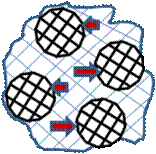
Figure 8.5: Embryogenic callus with PEMs (indicated by arrows) in the induction medium