4.3. Nitrogen source
The most important nutrient of the culture medium is nitrogen which affects SE significantly. The form of nitrogen have a strong influence on the induction of SE. Often the presence of ammonium or some other source of reduced nitrogen is required, such as glycine, glutamate or casein hydrolysate. The ratio of ammonium to nitrate has also been shown to affect SE. In few cases, the calli initiated on a medium with KNO3 as the sole source of nitrogen failed to form embryos upon removal of auxin. However, the addition of a small amount (5mM) of nitrogen in the form of NH4Cl in the presence of 55mM KNO3 allowed embryo development.
5. Embryo maturation and germination
Germination of somatic embryos can occur only when it is mature enough to have functional shoot and root apices capable of meristematic growth. Somatic embryos show poor germinable quality with respect to their convertibility into complete plantlets. This is because these embryos do not go through ‘embryo maturation' phase which is the characteristic of seed or zygotic embryos. During this phase, accumulation of embryo-specific reserve food materials and proteins imparts desiccation tolerance to seed embryos and thereby promote their normal development for germination. Abscisic acid (ABA), which prevents precocious germination and promotes normal development of embryos by suppression of secondary embryogenesis and pluricotyledony, is reported to promote embryo maturation in several species. A number of other factors, such as temperature, shock, osmotic stress, nutrient deprivation and high density inoculums, can substitute for ABA, presumably by inducing the embryos to synthesize the hormone. ABA is known to trigger the expression of genes which normally express during the drying down phase of seeds. Probably the products of these genes impart desiccation tolerance to the embryos.
6. Secondary somatic embryogenesis
Secondary SE is a process in which new somatic embryos are proliferated from originally formed primary somatic embryos. Secondary SE is reported to have some advantage over primary somatic embryogenesis, such as high multiplication rate, long term repeatability and independency of an explant source. By repeated secondary SE selected embryogenic lines can be maintained for long period, in large quantities until the lines have been tested in field conditions particularly in perennial plants. Secondary SE also overcomes post fertilization barriers of the embryo, immature embryos of interspecific plants from incompatible crosses may be rescued by culturing them for secondary SE. It can also be used for the production of somatic embryos of species in which the embryos are the reservoir of important secondary metabolites. In Azadirachta indica, for secondary SE, primary embryos were used as the explant and when cultured on medium with TDZ and GA3, secondary embryos were differentiated directly from hypocotyls region without any intervening callus (Figure 8.8A). Whereas, a combination of BAP and IAA resulted into secondary SE preceded by callusing of the primary somatic embryo (Figure 8.8B).
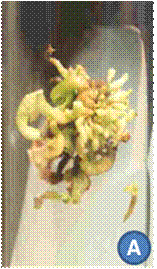
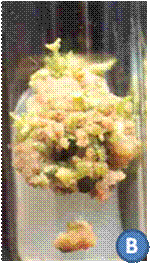
Figure 8.8: Primary somatic embryo showing: A. direct secondary somatic embryogenesis B. indirect secondary somatic embryogenesis
7. Synchronization of embryo development
Generally, the differentiation of somatic embryos in semi-solid medium or liquid medium is highly asynchronous which adversely affect the germination rate. Synchronization of embryo development is very important for artificial seed technology. Of the several approached tried to achieve this, the most effective method are the physical separation of embryogenic stages and use of growth regulators to physiologically synchronize the development. The other alternative methods are the fractionation of embryos of different stages by filtration of suspension through meshes of different sizes or by gradient centrifugation. Besides, the most effective method to achieve synchronous development of somatic embryos is the use of substances that would induce reversible cessation of embryo development at a particular stage. ABA at low concentration is the most satisfactory substance for the purpose. For example, in carrot it inhibits the growth of roots and enhances suspension with torpedo shaped embryos.