In either of the cases, the somatic embryos resemble the zygotic embryos. In dicotyledonous plants, the somatic embryos passes through the globular, heart, torpedo and cotyledonary stages, as happens in zygotic embryos (Figure 8.4). The embryos germinate and develop into complete plantlets. The only major difference between somatic and zygotic embryogenesis is that somatic embryos do not pass through the desiccation and dormancy phases as happens in zygotic embryos, but rather continue to participate in the germination process.
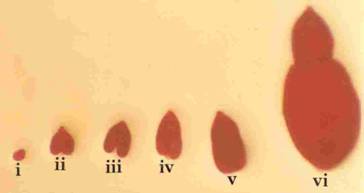
Figure8.4: Different stages of development of zygotic embryos: (i) globular, (ii) early heart shape, (iii) late heart shape, (iv) torpedo shape, (v) early dicot, and (vi) fully developed dicot embryo
Whether originating directly or indirectly via callusing, somatic embryos arise from single special cells located either within clusters of meristematic cells in callus mass or in the explant tissue. Somatic embryogenesis is regarded as a three step process:
- i. Induction of embryo
ii. Embryo development
iii. Embryo maturation
3. Organogenesis versus embryogenesis
In tissue cultures, plant regeneration via somatic embryogenesis may offer many advantages over organogenesis, such as
- i. Embryo is a bipolar structure rather than a monopolar one.
ii. The embryo arises from a single cell and has no vascular connection with maternal callus tissue or the cultured explant. On the other hand during organogenesis shoots or roots develop from a group of cells resulting into chimera formation which later establish a strong connection with the maternal tissue.
iii. Further, induction of somatic embryogenesis requires a single hormonal signal to induce a bipolar structure capable of forming a complete plant, while in organogenesis, it requires two different hormonal signals to induce shoot first and then root organ.